IndiGo Introduces Cheaper Cabin-Baggage-Only Tickets
India's largest airline, IndiGo, has introduced a new 'IndiGo Lite' fare aimed at passengers travelling with only cabin baggage, offering lower ticket prices by removing services that many budget travellers may not require. The initiative reflects a growing trend in the aviation industry towards unbundled pricing, where passengers pay only for the services they choose to use. Designed for both domestic and international non-stop flights, the new fare seeks to make air travel more affordable while giving travellers greater flexibility in customising their journey. As airlines continue to grapple with rising operational costs and intense competition, such pricing models are rapidly becoming an important feature of India's evolving aviation market.
Shift Towards Flexible and Unbundled Airfares
Traditionally, airline tickets bundled several services—including check-in baggage, seat selection and onboard meals—into a single fare irrespective of whether passengers used them. However, increasing fuel costs, operational expenses and fierce price competition have prompted airlines worldwide to rethink this model.
Indian carriers have faced additional challenges in recent months due to elevated aviation turbine fuel (ATF) prices following geopolitical tensions in West Asia, temporary airspace restrictions and competitive pricing pressures across domestic routes. Against this backdrop, airlines are increasingly separating individual services from the base fare, enabling customers to purchase only those amenities they require while allowing airlines to generate additional revenue through optional add-ons.
What IndiGo Lite Offers
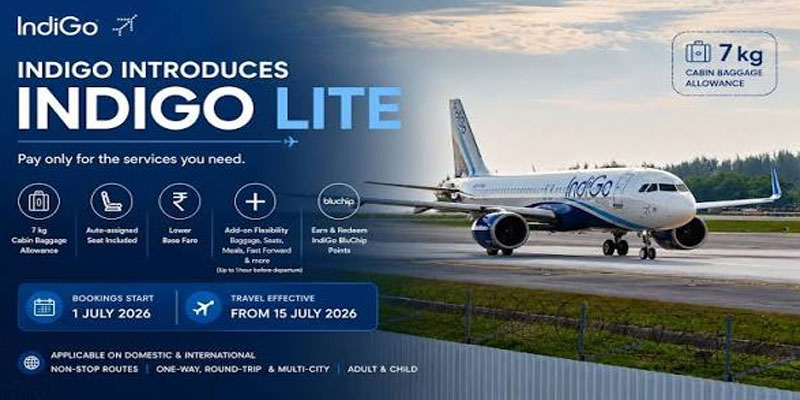
The newly launched IndiGo Lite fare is available for economy-class passengers travelling on domestic and international non-stop services. Under this category, travellers receive a lower base fare, an automatically assigned seat at no extra charge and permission to carry up to 7 kilograms of cabin baggage.
The fare excludes complimentary check-in baggage, but passengers who require additional services can purchase them separately. Optional add-ons include checked baggage, preferred seating, onboard meals and priority airport services, allowing customers to tailor their travel experience according to their individual requirements.
Initially, the fare is being offered exclusively through IndiGo's direct booking channels from July 1, with travel under the new category commencing from July 15. Importantly, passengers will continue to earn and redeem benefits under the airline's BluChip loyalty programme, making the product more attractive than a conventional stripped-down discount fare.
Industry Trend: Air India Also Adopts Similar Strategy
IndiGo's latest initiative reflects a broader transformation in airline pricing strategies rather than an isolated commercial decision. Rival Air India has also introduced a basic economy fare targeted at price-conscious travellers, which excludes complimentary meals while maintaining access to other core travel services.
The convergence of pricing strategies between a low-cost carrier and a full-service airline illustrates how the aviation industry is increasingly segmenting customers based on travel preferences rather than offering uniform economy-class products. Business travellers carrying only cabin baggage, short-haul passengers and budget-conscious flyers stand to benefit the most, as they no longer need to pay for services they may never use.
For airlines, this model offers greater pricing flexibility, helps preserve profit margins amid rising operating costs and encourages customers to book directly through airline platforms, thereby increasing ancillary revenue opportunities.
A New Pricing Model for Modern Air Travel
The introduction of IndiGo Lite signals a significant evolution in India's aviation sector, where affordability and personalisation are becoming equally important. Instead of lowering service standards, airlines are redefining value by allowing passengers to choose only the services they need. Air India's adoption of a similar basic economy fare further indicates that flexible pricing is becoming an industry-wide strategy. As competition intensifies and operating costs remain elevated, unbundled fares are likely to become increasingly common, offering travellers greater transparency and lower entry-level prices while helping airlines build more sustainable revenue models in an increasingly competitive market.
(With agency inputs)