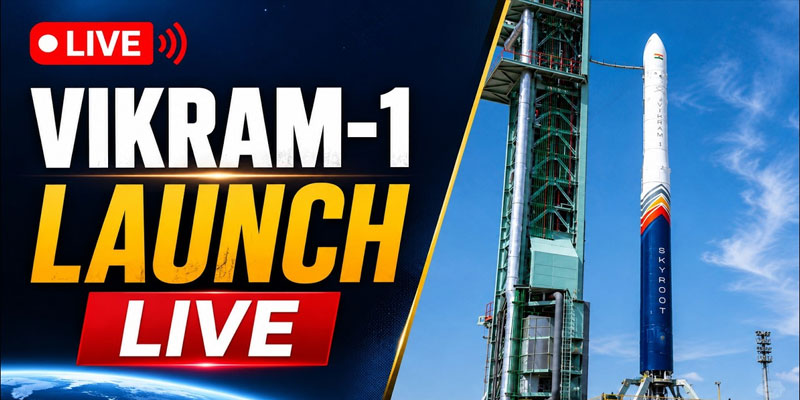
Skyroot Launches India's First Private Orbital Launch Vehicle
Skyroot Aerospace created history on Saturday by launching Vikram-1, India's first privately developed orbital launch vehicle, from the Satish Dhawan Space Centre, Sriharikota, under Mission Aagaman. The landmark mission marks a defining moment for India's commercial space sector, signalling the country's transition from a government-led launch ecosystem to one where private companies can independently build and launch orbital rockets. While the maiden mission is primarily a technology demonstration, it is widely seen as a breakthrough for India's ambitions in the global small-satellite launch market.
From Policy Reforms to Private Launch Capability
India's private space journey gained momentum through ISRO's gradual commercialisation initiatives, followed by the establishment of NewSpace India Limited (NSIL) and the Indian National Space Promotion and Authorisation Centre (IN-SPACe). The Indian Space Policy 2023 further opened the sector by permitting private companies to build and operate launch vehicles and satellites.
Founded by former ISRO engineers, Skyroot Aerospace first demonstrated its capabilities with the successful sub-orbital Vikram-S mission in November 2022. Building on that success, the company developed Vikram-1, a four-stage, expendable launch vehicle capable of placing around 300-350 kg payloads into low Earth orbit, with a focus on dedicated launches for small satellites.
Mission Aagaman: A Landmark Flight
Launched from the First Launch Pad at Sriharikota, the seven-storey Vikram-1 carried multiple technology demonstration payloads from Grahaa Space, Cosmoserve, DCubed and Skyroot's own SCOPE platform. The mission also included symbolic payloads such as the "Cosmic Bloom" artwork and lab-grown diamond art, showcasing India's growing soft-power ambitions in space exploration.
Beyond payload deployment, the mission's primary objective is to gather high-quality flight data on propulsion, stage separation, guidance, navigation, structural loads and overall vehicle performance. The findings will be used to refine future commercial missions and improve launch reliability.
A New Chapter for India's Space Industry
Vikram-1 has been designed as a dedicated launcher for small satellites, offering customers greater scheduling flexibility and precise orbital insertion compared to conventional rideshare missions.
By successfully fielding an orbital-class rocket from an ISRO launch pad, Skyroot has demonstrated that Indian private companies are now capable of delivering end-to-end launch services. If the mission achieves its planned orbital objectives, India will join a select group of nations where a domestic private company can independently place satellites into orbit, strengthening its competitiveness in the rapidly expanding global launch market.
The Call to Prime Minister Modi
Soon after the launch, the Skyroot team called Prime Minister Narendra Modi to share the milestone. Congratulating the scientists and engineers, the Prime Minister described the launch as a proud moment for India's space ecosystem and applauded the team's innovation and perseverance. He said the achievement reflected the success of India's space-sector reforms and encouraged the team to continue pushing technological boundaries, assuring them of the government's continued support for the country's growing private space industry.
A Giant Leap Beyond Government-Led Space Missions
Mission Aagaman represents far more than the maiden flight of a rocket. It demonstrates that India's policy reforms are translating into tangible technological and commercial achievements. For investors, startups and the global satellite industry, Vikram-1 signals that India is emerging as a credible destination for affordable, reliable and indigenous launch services. As ISRO increasingly assumes the role of regulator, mentor and technology partner, companies like Skyroot are poised to drive the next phase of India's space economy. The success of Vikram-1 is therefore not merely a launch milestone but the beginning of a new era in which public policy, private innovation and national ambition converge to redefine India's place in the global space race.
(With agency inputs)