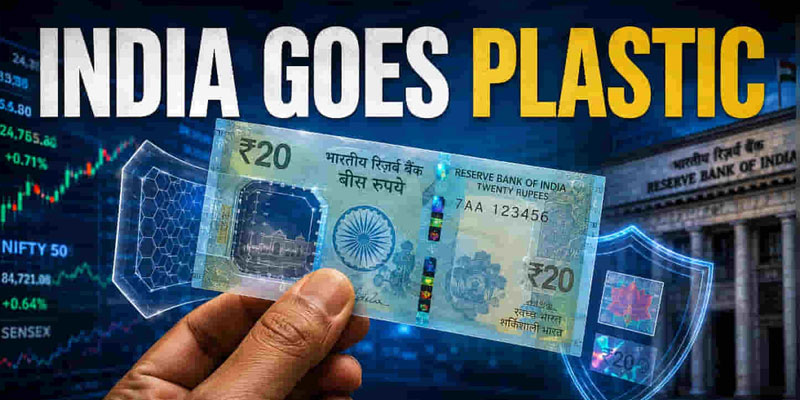
RBI Gets Government Approval for Polymer Note Trials
In a significant step towards modernising India's currency management system, the Central Government has approved the Reserve Bank of India’s (RBI) proposal to conduct field trials of 2 billion polymer banknotes—comprising 1 billion ₹10 notes and 1 billion ₹20 notes. While the approval marks a major policy milestone, officials have clarified that there is no official launch date for public circulation. Any broader rollout will depend entirely on the success of these real-world trials. Importantly, the initiative is being viewed as a durability and cost-efficiency experiment, rather than a replacement of conventional paper currency, which will continue to remain in circulation.
A Long-Pending Experiment Returns
India’s interest in polymer currency is not new. The first proposal emerged in 2012, when the Centre approved pilot testing of polymer ₹10 notes in select cities. However, the initiative was eventually shelved due to technological challenges, including printing complexities, ATM compatibility issues and operational limitations.
More than a decade later, the revival of the proposal indicates that the RBI believes these technical hurdles can now be addressed with improved technology and better infrastructure. The focus on ₹10 and ₹20 notes is particularly significant, as these are among the country's most frequently exchanged denominations and suffer the highest levels of wear and tear.
Why Polymer Notes Make Economic Sense
The RBI's proposal is backed by international studies suggesting that polymer banknotes last substantially longer than traditional paper notes. Although polymer notes cost more to manufacture initially, their extended lifespan could significantly reduce the frequency of replacement, thereby lowering overall lifecycle costs.
Apart from durability, polymer notes offer several additional advantages. They are more resistant to moisture, dirt and rough handling, making them suitable for India's diverse climatic conditions. They also incorporate advanced security features that make counterfeiting more difficult, enhancing the integrity of the currency system while improving usability for everyday transactions.
Field Trials Will Determine the Future
The current approval is strictly for field testing, not nationwide circulation. Reports indicate that Bharatiya Reserve Bank Note Mudran Private Limited (BRBNMPL) has already floated a global tender to procure polymer substrate, signalling that preparations have entered the procurement stage.
During the trials, authorities will closely monitor several critical parameters, including the notes' durability, public acceptance, machine compatibility, security performance and their ability to withstand India's varied weather conditions. ATMs, currency sorting machines and cash-handling systems will also be evaluated for seamless operation with the new notes. Only after satisfactory performance across these benchmarks will the RBI consider a phased commercial rollout.
Cash and Digital Payments Can Coexist
The Finance Ministry has dismissed concerns that polymer notes could undermine India's rapidly expanding digital payment ecosystem. According to the government, cash and digital payments are complementary rather than competing modes of transaction.
This reflects India's evolving payment landscape, where platforms like UPI continue to witness record growth, even as cash remains indispensable for millions of small-value, rural and informal-sector transactions. Strengthening the quality of physical currency is therefore viewed as supporting, rather than slowing, the country's broader financial ecosystem.
Testing Before Transformation
The success of this initiative will ultimately depend on how polymer notes perform under real-world Indian conditions. Durability, machine compatibility, replacement savings and public confidence will determine whether the experiment evolves into a nationwide programme. Rather than signalling a dramatic shift away from paper currency, the RBI's cautious approach reflects a data-driven effort to enhance efficiency, reduce long-term costs and strengthen currency security. If the trials prove successful, polymer notes could become a practical and sustainable upgrade for India's most widely used denominations while preserving the coexistence of both cash and digital payment systems.
(With agency inputs)