Naval Power at the Heart of India’s Security Strategy
As regional tensions escalate, particularly in the Arabian Sea, India’s naval capabilities are stepping into sharper focus. The Indian Navy, a cornerstone of the nation’s defence apparatus, plays a vital role in securing maritime trade routes, deterring adversaries, and asserting strategic dominance across the Indian Ocean Region (IOR). With the commissioning of INS Tamal—India’s latest multi-role stealth frigate sourced from Russia—India is taking a major leap in reinforcing its naval presence and asserting its position as a regional maritime power amid growing hostilities with Pakistan and strategic maneuvering by China.
INS Tamal: A Powerful New Asset in India’s Naval Arsenal
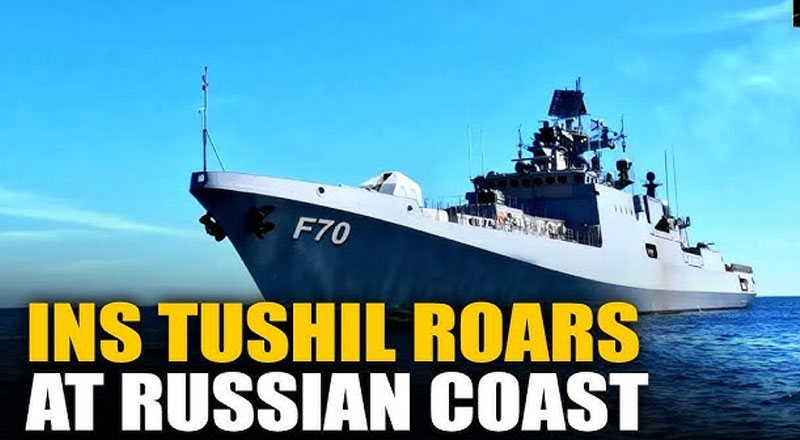
India is set to induct its second improved Krivak-III class frigate, INS Tamal, following the December 2024 commissioning of INS Tushil. Built in Russia and soon to be delivered after final weapon and sea trials in Kaliningrad, INS Tamal exemplifies India’s ongoing naval modernization. Weighing 3,900 tonnes and designed for blue-water operations, this stealth frigate integrates advanced sensors, automation, and multi-dimensional combat capabilities, making it a critical addition to India’s frontline naval fleet.
Equipped with the highly lethal BrahMos cruise missile system, Shtil surface-to-air missiles, and robust anti-submarine weaponry, INS Tamal enhances India’s ability to operate seamlessly across air, surface, and subsurface domains. It will significantly strengthen the Navy’s posture in the Arabian Sea—a maritime theatre now laden with strategic significance.
Arming for Supremacy: The Combat Systems on INS Tamal
INS Tamal is engineered for multidimensional warfare. Its BrahMos missiles, upgraded to a 450 km range, remain the most formidable cruise missiles in service globally. Capable of Mach 2.8–3.0 speeds and following a sea-skimming trajectory, the BrahMos offers unmatched precision and lethality.
Complementing this firepower are Shtil vertical-launch surface-to-air missiles, capable of neutralising aerial threats, and state-of-the-art anti-submarine torpedoes and rocket systems. These systems give the ship a balanced offensive-defensive architecture. Designed to deploy Kamov-28 and Kamov-31 helicopters, the vessel’s range of threat detection and operational agility is extended into the air and beneath the sea, making it an ideal deterrent in high-tension zones like the Arabian Sea.
With stealth capabilities to reduce radar, infrared, and acoustic signatures, INS Tamal is not just lethal—it’s hard to see, track, or target.
Building Indigenous Strength: Undersea Warfare Takes a Leap
Alongside acquiring state-of-the-art frigates, India is ramping up indigenous defence solutions. Recently, the Indian Navy successfully tested homegrown multi-influence ground mines—an advanced underwater weapon system capable of targeting stealth ships and submarines. Using magnetic, pressure, and acoustic triggers, these mines provide a smart, adaptive deterrent for undersea threats.
Though tested with limited explosives, the success of this trial signals a shift toward greater self-reliance in undersea warfare. Defence Minister Rajnath Singh hailed the development, stating it would give the Navy “confidence and capability in contested undersea zones.” Together with advanced platforms like INS Tamal, such systems build a layered defence strategy that enhances deterrence and strategic depth.
Strategic Role in the Arabian Sea: A Response to Regional Shifts
The deployment of BrahMos-equipped stealth frigates like INS Tamal in the Arabian Sea is no coincidence. Rising tensions with Pakistan, especially post the Pahalgam terror attack, and China’s expanding naval footprint in the IOR have compelled India to reassess and reinforce its maritime strategy.
INS Tamal’s presence is part of a larger effort to maintain credible sea control and deterrence in a region that sees over 60% of India’s energy imports and a significant portion of global trade. It boosts India's ability to monitor and, if necessary, neutralise threats originating from adversarial naval deployments, particularly those of the Pakistan Navy, which has increasingly aligned with China's strategic interests.
India’s Edge Over the Pakistan Navy
Comparatively, India holds a qualitative and quantitative edge over Pakistan’s navy. With 19 active frigates—compared to Pakistan’s 8—India’s fleet is not only larger but more versatile and better armed. Pakistan’s newest additions, the Chinese-built Tughril-class (Type 054A/P) frigates, do present credible improvements with CM-302 anti-ship missiles and LY-80N surface-to-air systems.
However, the BrahMos missile far outstrips the CM-302 in speed, operational flexibility, and survivability. Moreover, India’s Barak-8 air defence systems integrated into several ships, including upcoming Project 17A vessels, outperform Pakistan’s LY-80N in range and reaction time. Where Pakistan seeks regional sea denial, India seeks full-spectrum control and strategic deterrence.
A Balanced Modernisation: Russian Collaboration and Indigenous Push
INS Tamal’s arrival also underscores India’s dual-track naval strategy: leveraging strategic partnerships while building domestic capability. The Krivak-III programme is part of a 2016 India-Russia agreement for four advanced frigates—two built in Russia and two in India’s Goa Shipyard via technology transfer. This model not only delivers immediate capability but also strengthens indigenous shipbuilding, as seen in the concurrent development of Nilgiri-class frigates under Project 17A.
This mix of foreign collaboration and local innovation allows India to modernize swiftly while nurturing self-reliance in naval production.
Naval Dominance Through Strategic Integration
The Indian Navy’s recent moves reflect a calculated, integrated approach. It’s not just about ships—it’s about systems, doctrines, and partnerships. Combining assets like INS Tamal with indigenous mine warfare systems and new-generation destroyers and submarines, India is developing a comprehensive maritime posture.
This synergy ensures India can protect strategic chokepoints, maintain maritime domain awareness, and project power far from home ports. It also acts as a deterrent to hostile powers like Pakistan, which, despite recent acquisitions, still lacks the operational reach and strategic flexibility of the Indian Navy.
Commanding the Seas, Securing the Future
The induction of INS Tamal into the Indian Navy marks more than the arrival of a new warship—it signals India’s intent to dominate its maritime backyard with precision, power, and preparedness. As regional waters grow increasingly contested, and strategic rivalries sharpen, India's robust, layered naval strategy is both timely and essential.
INS Tamal, supported by indigenous innovations and strategic partnerships, reinforces India's vision of being not just a continental power, but a decisive maritime force in the 21st century. In the great geopolitical chessboard of the Indo-Pacific, India's navy isn't just holding the line—it's defining it.
(With inputs from agencies)
LATEST NEWS