A Renewed Chapter in a Historic Relationship
The ties between India and the United Kingdom—rooted in shared history, democratic values, and cultural bonds—are entering a dynamic new phase. As the world faces complex geopolitical shifts, both nations are discovering fresh avenues to collaborate on trade, education, and defence. The recent visit of British Prime Minister Keir Starmer to India marks a defining moment in this partnership, reinforcing mutual commitment to innovation, stability, and sustainable growth. His trip, coming just months after the signing of a landmark trade agreement, underscores the depth of intent from both sides to translate diplomacy into tangible progress.
Trade and Transformation: The Economic Backbone of a Stronger Alliance
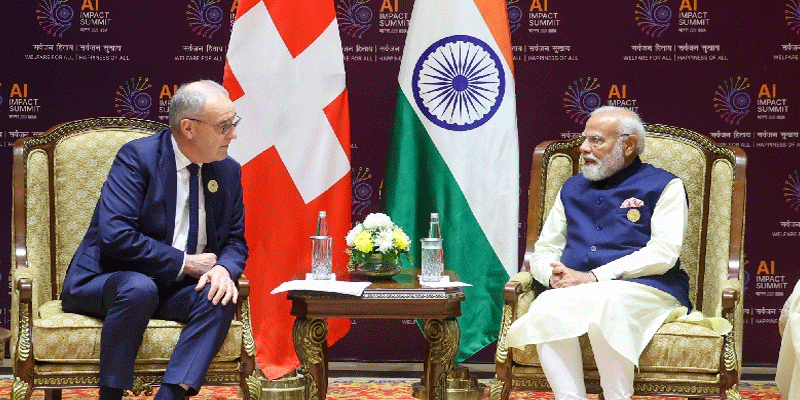
Meeting at Raj Bhavan in Mumbai, Prime Minister Narendra Modi and Prime Minister Keir Starmer held wide-ranging discussions to elevate the India-UK Comprehensive Strategic Partnership, guided by the long-term Vision 2035 roadmap. Their dialogue centered on trade, technology, and global peace, with Modi affirming that the Comprehensive Economic and Trade Agreement (CETA)—signed in July 2024—had already begun transforming economic relations.
“This agreement will not only reduce import costs but also generate new employment opportunities for our youth, stimulate trade, and empower industries and consumers in both countries,” Modi declared during a joint press conference. He hailed Starmer’s leadership for injecting “new vigour” into the relationship, while noting that this visit, accompanied by the largest-ever UK business delegation, symbolizes a shared determination to unlock bilateral potential.
Starmer’s delegation, featuring 126 British companies, is expected to pave the way for joint ventures in renewable energy, digital services, manufacturing, and critical minerals—sectors pivotal to both economies.
Education and Innovation: Building Knowledge Bridges
A key highlight of the discussions was the expansion of educational cooperation. Modi announced that nine British universities are set to establish campuses in India, marking an unprecedented step in academic collaboration. The University of Southampton’s Gurugram campus has already begun operations, enrolling its first batch of students.
“This represents the largest and most influential educational delegation from the UK so far,” Modi said, emphasizing that such initiatives will nurture talent, strengthen research networks, and prepare young minds for a globally connected future.
Additionally, both nations will collaborate on training programs for Indian Air Force instructors, further cementing ties in the defence sector. To boost industrial coordination, Modi revealed plans to create an Industry Guild and Supply Chain Observatory for cooperation on critical minerals, with a satellite campus at the Indian School of Mines in Dhanbad—a step toward shared technological and energy security.
Strategic Dialogue: Stability in an Uncertain World
Beyond economics, the Modi–Starmer dialogue extended to pressing international issues, including the Indo-Pacific region, West Asia, and the ongoing Ukraine conflict. Modi reiterated India’s support for “peace through dialogue and diplomacy,” reaffirming New Delhi’s stance as a responsible global actor.
“In this era of global instability, the growing partnership between India and the UK forms an essential foundation for peace and economic progress,” Modi observed. The two leaders also discussed enhancing maritime security and regional cooperation in the Indo-Pacific—a region critical to maintaining global trade balance and strategic stability.
Starmer’s Reflections: Admiration for India’s Growth Story
Expressing deep admiration for India’s economic transformation, Starmer said, “Meeting in Mumbai—the financial heart of India—is symbolic. India’s growth story is truly remarkable.” He praised Modi’s vision of Viksit Bharat 2047, India’s mission to become a fully developed nation by its centenary of independence, calling it “a vision the UK is proud to partner in.”
He added, “Everything I have witnessed on this visit proves that India is on track to become the world’s third-largest economy by 2028. My mission here is to double down on our trade deal’s potential—for the benefit of both our peoples.”
Partners in Progress, Anchors of Global Stability
The meeting between Prime Ministers Modi and Starmer signals not merely a diplomatic engagement but the dawn of a strategic partnership grounded in shared ambition and mutual respect. From trade and education to defence and global governance, the India–UK relationship now stands as a model of modern cooperation. As both democracies align their economic and geopolitical priorities, they reaffirm a common purpose—to foster prosperity, stability, and opportunity, not just for their citizens but for the world at large.
In the words of Modi, “India and the UK are natural partners—and together, we are shaping a future that is stronger, fairer, and more resilient.”
(With agency inputs)a