A Season Ends Just as Momentum Was Returning
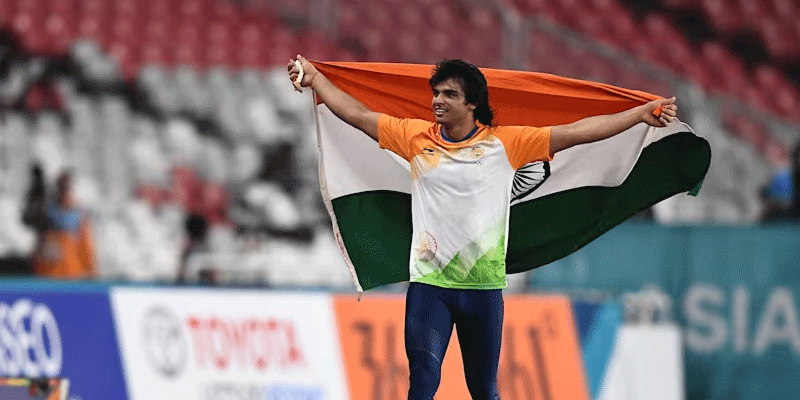
Neeraj Chopra will miss the remainder of the 2026 athletics season, including the Asian Games in Aichi-Nagoya, after suffering a ligament tear in his ankle during training. The injury removes India’s defending Asian Games javelin champion from one of its strongest medal events and abruptly ends a season in which Chopra had finally begun rebuilding momentum after repeated fitness setbacks.
For Indian athletics, his absence is a significant competitive and symbolic loss. For Chopra, however, the decision represents a calculated choice to protect his long-term career rather than risk further damage.
Chopra Confirms the Injury
Chopra announced on August 29 that he suffered the ankle injury shortly after producing his season-best performance at the Lausanne Diamond League. The 28-year-old said discussions with his medical team led to the decision to sit out the rest of the season.
His withdrawal comes just as his competitive form was improving. Chopra threw 88.05 metres in Lausanne, finishing second and recording his best mark of the season. The performance suggested that the Olympic champion was rediscovering the consistency and rhythm that have defined his career.
A Season Already Marked by Setbacks
The ankle tear compounds an already difficult 2026 campaign. Chopra delayed his return because of a lower-back problem and had previously dealt with concerns involving his Achilles, groin, shoulder and elbow.
Lausanne appeared to signal a turning point. Although 88.05m remained below his 89.94m personal best and the elusive 90-metre barrier, it demonstrated that his competitive edge was returning.
Why Rushing Back Would Be Risky
Javelin places extraordinary forces on the lower body, particularly during the final blocking phase, when an athlete rapidly transfers momentum through the ankle, knee, hip, torso and throwing arm.
A premature return could aggravate the ligament injury or create compensatory problems elsewhere. With the Los Angeles 2028 Olympic cycle approaching, rehabilitation and restoring full physical stability are therefore more important than defending one title.
India Loses Its Biggest Asian Games Asset
Chopra won Asian Games gold in Hangzhou in 2023 with a throw of 88.88 metres and was expected to defend that crown in Japan. His absence significantly alters India’s medal prospects while giving rivals, including Pakistan’s Olympic champion Arshad Nadeem, a stronger opportunity.
The impact goes beyond one event. Chopra is India’s only Olympic athletics gold medallist, having won at Tokyo 2020 before taking silver at Paris 2024. His achievements have elevated Indian athletics, increased attention on field events and inspired a generation of competitors.
The Bigger Victory Is Long-Term
India will miss its most dependable javelin champion at Aichi-Nagoya, but Chopra’s withdrawal should be viewed through a wider lens. An athlete’s career is measured across seasons, not a single championship.
The Asian Games may lose one of their biggest stars, but protecting Chopra’s health protects India’s medal hopes for years to come. In this case, stepping away from competition is not surrender—it is the disciplined decision to return stronger when the stakes are even higher.
(With agency inputs)