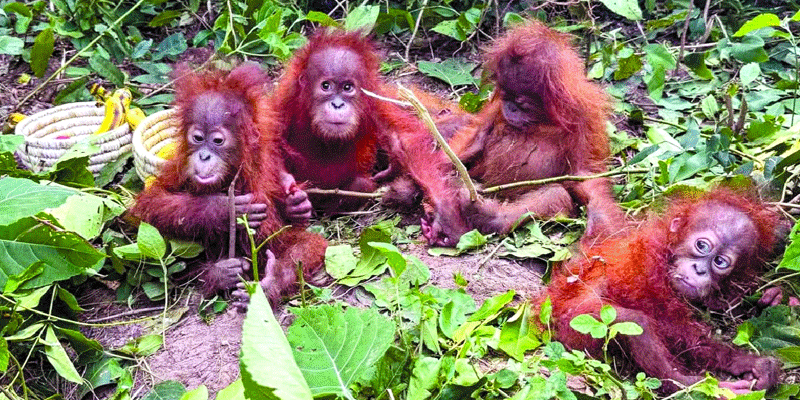
The discovery of five infant orangutans in a coastal forest in Odisha has exposed what investigators and conservation experts believe could be the visible edge of a much larger, largely hidden international wildlife-trafficking network. The unusual rescue has raised fresh questions about how endangered species are moved through India’s maritime and transport corridors.
From Southeast Asian Forests to Odisha
Orangutans are native only to the rainforests of Borneo and Sumatra in Indonesia and Malaysia. Classified as critically endangered, they receive stringent international protection under CITES, while India’s Wild Life (Protection) Act provides additional legal safeguards against their illegal possession and trade.
Yet lucrative demand for exotic pets and private collections continues to fuel trafficking in endangered primates, reptiles, birds and other wildlife. India’s extensive coastline, international shipping routes, porous borders and busy road and rail networks can make the country both a destination and transit point for illicit wildlife consignments.
Latest Developments
· Five infants rescued: On September 8, villagers in Balasore district discovered five baby orangutans—three males and two females, estimated to be six months to one year old—clinging to trees in a casuarina plantation near the Ranakatha/Udayapur-Talsari forest area, close to NH-16 and the West Bengal border.
· Animals shifted to Nandankanan: The infants were reportedly mildly dehydrated but otherwise healthy. They were rescued without tranquilisation and transported to Nandankanan Zoological Park in Bhubaneswar, where they have been placed under quarantine and medical observation.
· Multi-agency investigation: The Odisha Police Special Task Force, Forest Department and Wildlife Crime Control Bureau have joined the investigation to establish how the animals entered Odisha and identify those responsible. Investigators are examining CCTV footage from ports, railway stations, airports and major highways, alongside possible maritime routes across the Bay of Bengal.
· High-value trafficking: Authorities suspect the orangutans may have been smuggled from Southeast Asia by sea and intended for private collectors or illicit buyers. Their estimated black-market value of around ₹20–25 lakh each places the consignment’s potential value above ₹1.25 crore.
· Possible “panic drop”: Investigators and experts suspect the animals may have been abandoned after traffickers encountered an unexpected problem—such as heightened surveillance, a failed handover or a transport breakdown. Such emergency abandonment is sometimes described as a “panic drop”.
The Bay of Bengal’s Hidden Vulnerability
The case matters because the five orangutans may represent far more than an isolated trafficking incident. Wildlife smuggling increasingly exploits the same logistical weaknesses used by other forms of organised transnational crime: complex supply chains, concealed consignments, informal intermediaries and fragmented enforcement.
For India, the episode also highlights the need for stronger screening at ports and transport hubs, better intelligence sharing and closer coordination among customs, police, forest officials and international wildlife authorities. DNA testing and species profiling could help establish the animals’ origins and support eventual repatriation in coordination with CITES and source countries.
Rescue Five, But Expose the Network
The rescued orangutans are now safe, but their journey to Odisha points towards a darker global marketplace where endangered wildlife becomes a commodity. Their survival should therefore trigger more than a successful rescue operation. It should become an opportunity to identify the trafficking route, dismantle the syndicate behind it and strengthen India’s coastal defences against wildlife crime.
(With agency inputs)