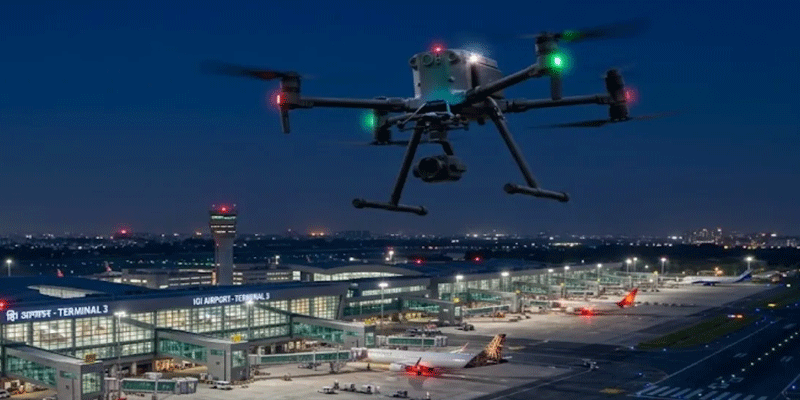
Suspected drone movement near Sri Guru Ram Das Jee International Airport in Amritsar triggered a security alert on Sunday night, prompting authorities to divert seven incoming flights, including two international services, to Delhi and Chandigarh. Landing operations were temporarily suspended for around 90 minutes as security agencies assessed the potential threat.
A Border Airport Under Constant Security Watch
Amritsar airport occupies a strategically sensitive position close to the India-Pakistan border while serving substantial domestic and international passenger traffic, including visitors travelling to the Golden Temple. Any unidentified aerial object near its operational area is therefore treated seriously, given both aviation-safety concerns and the region’s history of cross-border drone activity involving arms and narcotics.
The Directorate General of Civil Aviation (DGCA) maintains stringent restrictions on drone operations around airports. However, monitoring small consumer drones launched from surrounding semi-urban and rural areas remains challenging because such devices can be inexpensive, highly manoeuvrable and difficult to detect.
Suspected Drones Trigger Late-Night Airport Alert
According to officials, drone-like objects were observed near the runway and other sensitive areas around 10 pm, apparently approaching from the direction of Rudala village and remaining airborne for several minutes.
Air Traffic Control immediately alerted security agencies and suspended incoming landings as a precaution. The Central Industrial Security Force, Punjab Police and other security personnel were placed on heightened alert, while ground teams searched the airport perimeter and agencies monitored the surrounding airspace.
Seven flights bound for Amritsar were affected. Malaysia Airlines flight MH-118 from Kuala Lumpur, along with IndiGo 6E-1428 and Air India Express IX-120 from Sharjah, were diverted to Delhi. Two Air India flights from Delhi—AI-479 and AI-855—were turned back, while IndiGo flights 6E-5028 from Mumbai and 6E-2045 from Delhi were diverted to Chandigarh.
Three outbound flights from Amritsar were also cancelled while the precautionary suspension remained in force.
Investigation Underway as Identity Remains Unclear
Despite the serious disruption, authorities have not yet conclusively established whether the objects were drones, other unmanned aerial vehicles or something else. Their origin, number and possible intent remain under investigation.
The episode nevertheless demonstrates how even an unconfirmed aerial threat can rapidly affect airport operations. The decision to halt landings and redirect aircraft reflects the aviation sector’s safety-first approach, particularly at a strategically sensitive border location.
Low-Cost Drones, High-Impact Consequences
The Amritsar alert highlights a broader challenge confronting India’s aviation and security architecture. Small drones can potentially disrupt airports, critical infrastructure and transport networks without requiring sophisticated resources. At border airports, the implications are even greater because unidentified aerial activity can carry both security and operational risks.
India therefore needs stronger integration between ATC, airport security, local police and specialised counter-drone units. Better detection systems, including radar and radio-frequency monitoring, alongside appropriate counter-drone capabilities, can improve response times. Equally important is stronger enforcement in villages and settlements surrounding restricted airspace, supported by public awareness about no-drone zones.
Security Must Stay Ahead of the Drone Threat
The Amritsar incident may have ended without confirmed damage, but its message is unmistakable: a small unidentified drone can create a major national aviation disruption. Preventing future incidents will require more than temporary alerts and flight diversions. Persistent surveillance, faster inter-agency coordination and effective local enforcement must become integral to airport security.
For strategically located airports such as Amritsar, staying ahead of the rapidly evolving drone threat is no longer optional—it is essential to protecting passengers, infrastructure and the uninterrupted functioning of India’s aviation network.
(With agency inputs)