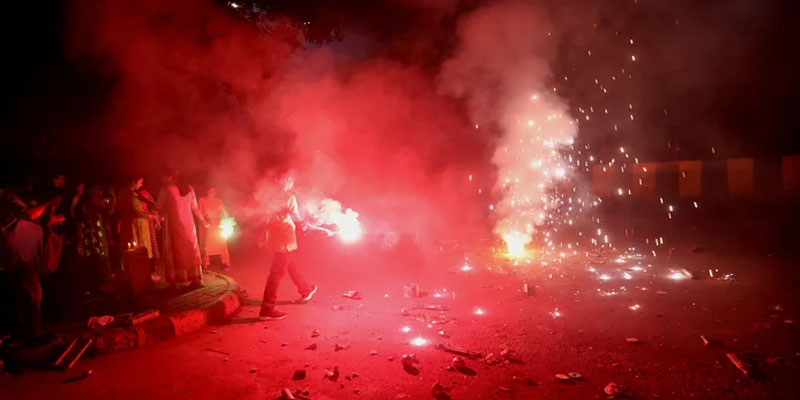
Pakistan has blamed deteriorating air quality this week on pollution drifting across the border from India, alleging that firecrackers burst during Diwali celebrations blanketed northern India and contributed to toxic smog in Lahore. The allegation has reignited the environmental and political debate between the two neighbouring countries. However, year-round pollution data indicate that Lahore's air-quality crisis is largely driven by domestic emissions and seasonal weather conditions, with cross-border pollution potentially adding to an already serious problem.
Pakistan's Allegations Against India
Punjab Environment Protection Minister Marriyum Aurangzeb attributed Lahore's deteriorating air quality to polluted air travelling from India under light wind conditions following Diwali.
On November 10, Lahore topped IQAir's ranking of the world's most polluted major cities for the second consecutive day, recording an AQI of 263, classified as very unhealthy. Its PM2.5 concentration was reportedly 37.2 times the World Health Organization's annual guideline.
There is a scientific basis for transboundary pollution, as airborne particles can travel across international borders depending on wind direction and atmospheric conditions. Fireworks in northern India could therefore have contributed additional particulate matter to the shared regional airshed.
However, attributing Lahore's pollution primarily to India requires closer examination of the available evidence.
Year-Round Data Reveal Lahore's Pollution Crisis
An assessment covering October 2025 to October 2026 found that Lahore's monthly average PM2.5 concentration remained above 35 micrograms per cubic metre throughout the period. Even during the relatively cleaner April-September months, monthly averages remained between 40 and 59 micrograms per cubic metre. Furthermore, between October 1 and November 9, Lahore recorded an average PM2.5 concentration of 126 micrograms per cubic metre. Pollution exceeded Pakistan's 24-hour air-quality standard on all 40 days with valid readings.
These figures demonstrate that Lahore's pollution problem existed well before Diwali.
Did Diwali Fireworks Significantly Worsen Lahore's Air?
Between 6 pm on November 8 and 1 am on November 10, Lahore's average PM2.5 concentration reached 234 micrograms per cubic metre, approximately 10% higher than during comparable hours in the preceding week.
However, Faisalabad and Multan experienced increases of approximately 40% during the corresponding comparison period.
This difference weakens the argument that Indian fireworks were the principal reason behind Lahore's deterioration. Local emissions, weather patterns and regional pollution accumulation appear to have played substantial roles.
Delhi and Lahore Share a Common Winter Crisis
Delhi also experienced severe pollution following Diwali, with its official AQI reaching 483. Weak winds, temperature inversion, vehicular emissions, industrial activity, construction dust and agricultural residue burning contribute to worsening winter air quality across northern India and Pakistan.
Beyond Blame, Towards Regional Environmental Cooperation
Cross-border pollution is scientifically possible, but treating Diwali as the principal explanation risks overlooking Lahore's persistent domestic pollution sources. Both countries need stronger controls on industrial emissions, vehicle exhaust, construction dust, waste burning and crop-residue burning. Ultimately, clean air cannot be secured through political accusations. India and Pakistan must recognise their shared environmental challenge and pursue coordinated airshed monitoring, scientific cooperation and sustained pollution-control measures rather than allowing a public-health crisis to become another bilateral confrontation.
(With agency inputs)