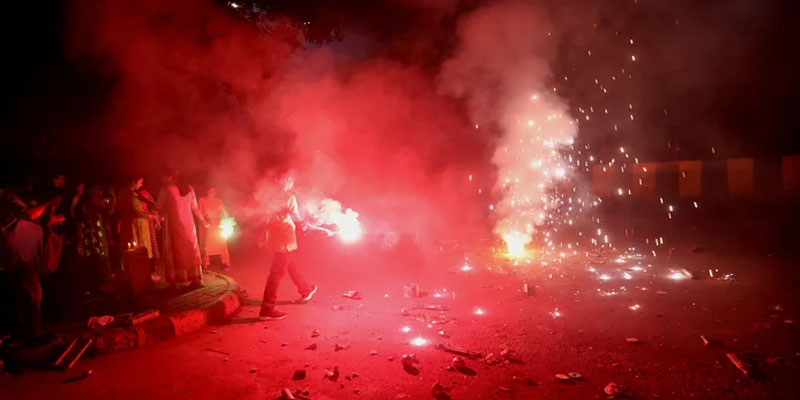
As Diwali smoke filled Delhi, an India Today ground check found blank public displays, missing live updates and a nearly 200-point difference between two air-quality screens the following day. The findings have intensified questions over the accuracy and transparency of pollution monitoring in the national capital. The political controversy has escalated, with the Aam Aadmi Party (AAP) accusing the BJP-led Delhi government of manipulating air-quality figures, while the ruling party has countered by blaming previous governments for decades of inadequate pollution control. At the centre of the confrontation is an alarming question: how bad was Delhi's air during and after Diwali, and were residents given an accurate picture of the danger?
Why Delhi's Air Turns Hazardous After Diwali
Delhi-NCR's pollution crisis typically worsens during October and November when several sources of emissions converge. Firecracker smoke adds to vehicle exhaust, industrial emissions, construction dust and agricultural residue burning in neighbouring states.
Falling temperatures, low wind speeds and atmospheric conditions also trap pollutants close to the ground, creating dense smog and reducing visibility.
The morning after Diwali, pollution levels deteriorated sharply across the capital. According to Central Pollution Control Board (CPCB) readings, the Air Quality Index (AQI) at ITO touched 406 around 4:20 a.m., while Ghazipur recorded 418. Both readings placed these locations in the severe category.
AQI 3,000 Paar: AAP Alleges Data Manipulation
AAP Delhi president Saurabh Bhardwaj launched a strong attack on the BJP government, alleging that pollution levels had crossed 3,000 in several parts of Delhi on Diwali night. Citing readings displayed by independent air-quality monitoring platforms and social-media posts, Bhardwaj questioned why the government's official figures appeared substantially lower than the pollution levels being reported elsewhere.
He raised several allegations:
· Monitoring stations: Existing pollution monitoring stations were allegedly shut down or rendered inactive.
· New locations: Around 20 new monitoring stations were allegedly established in remote or greener locations, potentially presenting a less representative picture of urban pollution.
· Water sprinkling: Bhardwaj alleged that water was sprinkled near monitoring equipment to influence readings.
· Missing transparency: He demanded publication of actual pollution figures and accused the government of misleading Delhi residents.
However, the claimed 3,000-plus AQI was not an officially validated, standardized citywide CPCB reading. Different monitoring platforms may use different sensors, measurement methods and reporting scales. Therefore, such readings cannot automatically be compared with the CPCB's official AQI.
Congress Questions Missing Monitoring Data
The Congress also joined the opposition attack, raising concerns about gaps in pollution monitoring.
Congress leader Ajay Maken alleged that 25 monitoring stations failed to record readings between 2 a.m. and 3 a.m. on November 9, citing CPCB data. He argued that missing hourly observations made it difficult to establish the complete extent of pollution during the critical post-Diwali period.
Earlier reports had also highlighted gaps in hourly PM2.5 and PM10 tracking, including 22 missing PM2.5 data points and 27 missing PM10 readings.
These allegations require official clarification and independent verification. Nevertheless, interruptions in pollution monitoring raise legitimate questions about the completeness of publicly available information.
BJP Hits Back: Who Is Responsible?
The BJP rejected the opposition's allegations and accused AAP and Congress of politicising the pollution crisis.
BJP MP Praveen Khandelwal argued that opposition parties selectively raised pollution concerns around Hindu festivals while overlooking the problem during their years in power. The BJP also pointed towards stubble burning in Punjab, highlighting the contribution of neighbouring states to Delhi-NCR's deteriorating air quality.
The Bigger Question: AQI Readings Versus Public Health
The AQI 3,000 controversy needs to be understood alongside the official measurements. India's CPCB uses a standardized AQI scale ranging from 0 to 500, with readings above 400 classified as severe.
Consequently, independent sensor readings exceeding 3,000 should not be presented as directly equivalent to the official CPCB index. However, official readings above 400 already indicate extremely hazardous conditions.
Beyond Political Blame, Delhi Needs Clean Air
The controversy exposes two interconnected failures: persistent pollution and declining public confidence in the information used to measure it. Whether the alleged manipulation occurred or not, the government must establish the credibility of its monitoring network through transparent, uninterrupted data publication and independent audits. Delhi's residents need reliable information, not competing political claims. Ultimately, clean air cannot become an annual festival-season debate that disappears when winter passes. It requires coordinated action, scientific monitoring and accountability across governments and neighbouring states.
(With agency inputs)