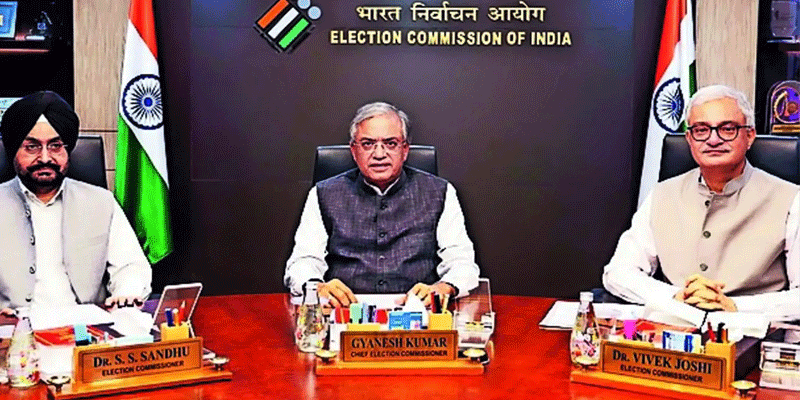
The SIR row has moved from an internal controversy within the Election Commission to a significant constitutional and legal dispute. At its centre are allegations that Chief Election Commissioner Gyanesh Kumar took several decisions linked to the Special Intensive Revision of electoral rolls without the concurrence of the other two Election Commissioners, raising questions about collective decision-making within the poll panel.
How the SIR Controversy Began
The controversy intensified after reports emerged that Election Commissioners Sukhbir Singh Sandhu and Vivek Joshi had raised objections to several decisions connected with the SIR exercise. The disputed matters reportedly include changes to Form 6, modifications to ECINet and ERONet software, and operational guidelines governing the revision process.
Petitioners argue that these changes went beyond routine administration and effectively altered electoral procedures without the required approval of the full Commission. They contend that the issue is particularly important because the Election Commission is a multi-member constitutional body whose decisions are governed by the framework established under the Constitution and the 2023 law governing the appointments and service conditions of the Commissioners.
Pleas Raise Questions Over Collective Authority
Several petitions have reached the Supreme Court seeking judicial intervention. Among the demands are scrutiny of the disputed SIR decisions, preservation of relevant records and, in some pleas, an independent investigation into alleged procedural irregularities.
The petitions broadly question whether:
· SIR-related decisions were taken collectively or unilaterally.
· Changes to electoral forms and digital systems received the legally required approval.
· Relevant records, including decision-making and digital audit trails, can establish how the disputed decisions were authorised.
· Decisions found to have violated the statutory framework should be withdrawn.
Supreme Court Seeks Answers, But Rejects Immediate Suspension
On October 5, a bench headed by Chief Justice Surya Kant, with Justices Joymalya Bagchi and V Mohana, declined to immediately suspend CEC Gyanesh Kumar. The Court made clear that it could not grant such relief merely on the basis of allegations or media reports without first hearing the concerned authorities.
However, the Court did issue notice to the Election Commission, the Centre, the CEC and the two other Election Commissioners. It directed the Commission to place details of the disputed decisions on record, including whether they were taken unanimously, by majority or solely by the CEC. The Court also indicated that decisions could be reconsidered if they were ultimately found to have been taken contrary to the applicable legal requirements.
Election Commission Defends Its Decision-Making
The Election Commission has maintained that differences of opinion and internal observations are part of institutional deliberation and do not by themselves establish illegality. It has asserted that its final decisions and directions carry legal sanction and have been issued through established procedures.
The Supreme Court's intervention therefore does not amount to a finding against the Commission. Instead, it places the disputed decision-making process under judicial examination and requires the relevant records to be produced.
The Larger Test: Institutional Accountability
The SIR controversy now extends beyond electoral-roll revision to a fundamental question of institutional governance: how should a constitutional body exercise collective power? The Supreme Court's next assessment of the records could determine whether the disputed decisions complied with the statutory framework. More broadly, the case may clarify how transparency, majority decision-making and accountability should operate within India's Election Commission—principles that carry significance far beyond the current SIR exercise.
(With agency inputs)