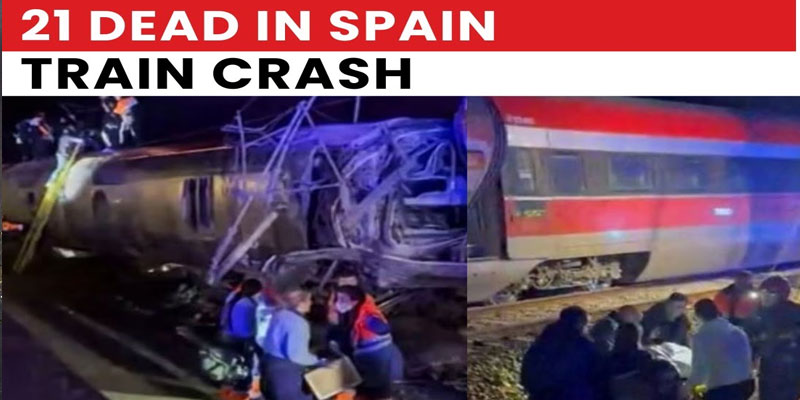
Deadly Crash Disrupts a Major High-Speed Corridor
A deadly train collision in Spain’s Toledo province has triggered a major emergency, disrupted high-speed rail services and renewed concerns about railway safety. At least 10 deaths were reported in the supplied account, with regional authorities warning that the toll could rise as rescue teams search damaged carriages. However, higher casualty figures circulating in some media reports remain unconfirmed by officials.
What Happened Near Toledo?
The collision reportedly occurred shortly after 9 a.m. on Wednesday near Urda, between Mora and Orgaz, south of Madrid. According to the account, a Renfe-operated train struck the rear of a stationary Iryo train, derailing two Iryo carriages.
Emergency personnel were deployed to evacuate passengers, treat the injured and search the wreckage. The full extent of casualties and the circumstances surrounding the collision remained unclear in the initial reports.
The investigation will need to establish why the trains came into conflict and whether operational or technical safeguards failed.
Madrid–Andalusia Rail Services Suspended
Spain’s rail infrastructure operator, ADIF, reportedly suspended high-speed services in both directions along the Madrid–Andalusia corridor. The disruption affects connections involving Madrid, Ciudad Real and Andalusia, including the busy Madrid–Seville route.
Restoring services could take time because authorities must secure the accident site, remove wreckage and inspect the tracks, signalling equipment and other infrastructure. Passengers may face cancellations, delays and the need to find alternative transport until operations resume safely.
Political Fallout and Renewed Safety Concerns
Prime Minister Pedro Sánchez expressed shock over the accident and offered support to victims and their families. The incident also carries political significance, particularly given concerns about rail safety following another deadly collision earlier in the year.
The supplied account cites a January crash in southern Spain that killed 45 people. If confirmed alongside the latest incident, the two tragedies would intensify pressure on authorities to explain whether existing safety measures adequately protect passengers.
What Investigators Must Establish
Investigators will focus on several critical questions:
· Why did one train collide with another reportedly stopped on the same line?
· Did signalling, automatic train protection or traffic-management systems function correctly?
· Could human error, equipment failure, track conditions or operational congestion have contributed?
· Were established safety procedures followed by the train operators and infrastructure managers?
No definitive cause should be assumed before investigators publish their findings. The functioning of train-separation and control systems will be especially important in determining how the collision occurred.
Safety Must Come Before Speed
The immediate priorities are completing rescue operations, confirming casualties, supporting survivors and restoring transport links when safe. Authorities must also communicate verified information clearly to prevent speculation about the death toll and the cause.
Ultimately, the tragedy underscores a fundamental principle: high-speed rail must combine efficiency with rigorous operational safeguards. If the reported sequence of events is confirmed, Spain will face urgent questions about whether its safety systems worked as intended. A transparent investigation, credible accountability and corrective action will be essential to restoring public confidence and ensuring that such a devastating collision is not repeated.