Understanding NATO and Its Spending Rules
The North Atlantic Treaty Organization (NATO), formed in 1949, is a 32-member military alliance built on collective defense — meaning that an attack on one member is considered an attack on all. Its strength depends heavily on the contributions of each member state, both financially and militarily.
NATO’s defense spending is measured as a percentage of a nation’s Gross Domestic Product (GDP), with a long-standing benchmark of 2% set as the minimum contribution target. While major powers like the United States, the United Kingdom, and Poland exceed this threshold, others, including Spain, Belgium, and Canada, remain below it. The recent geopolitical tension following Russia’s invasion of Ukraine in 2022 has reignited debates over how much each member should contribute to safeguard Europe’s security.
Trump’s Ultimatum: 5% or Face Tariffs
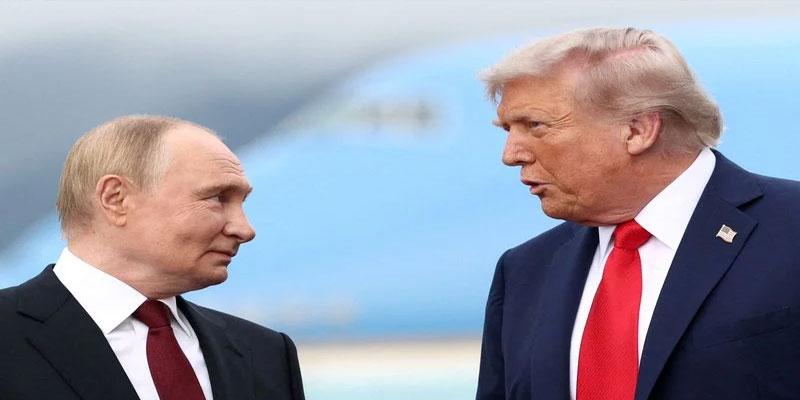
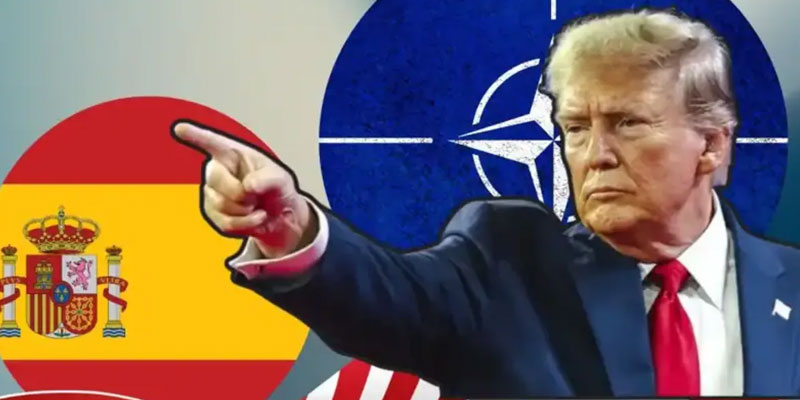
In a fresh escalation of transatlantic tensions, U.S. President Donald Trump on Tuesday threatened trade penalties, including tariffs, against Spain for refusing to raise its defense spending to 5% of GDP. Speaking to reporters at the White House, Trump said, “I’m very unhappy with Spain. They’re the only country that didn’t raise their number up to 5%… so I’m not happy with Spain.”
He went further, suggesting punitive economic measures: “I was thinking of giving them trade punishment through tariffs because of what they did, and I think I may do that.” Trump’s remarks follow his repeated criticism of NATO allies for “freeloading” on U.S. defense spending and his suggestion that Washington should reconsider supporting nations that “don’t pay their fair share.”
Just last week, during a meeting with Finland’s president, Trump even floated the idea of expelling Spain from NATO, calling its stance “disrespectful” to the alliance.
Spain’s Response: Commitment Beyond Budgets
Spain, however, has defended its record, emphasizing its active participation in NATO operations and “strong commitment” to transatlantic defense. Spanish Foreign Minister José Manuel Albares, speaking from Hangzhou, China, responded that Madrid remains “a reliable member of the alliance.”
“There is no doubt about Spain’s contribution to European and transatlantic security,” Albares said, pointing out that 3,000 Spanish troops are currently deployed under NATO command across Latvia, Slovakia, Romania, Bulgaria, and Turkey.
Spain’s Prime Minister Pedro Sánchez previously negotiated a temporary exemption from the proposed 5% target, arguing that 2.1% of GDP was “sufficient and realistic” given the country’s economic situation. Madrid insists that its operational contributions — personnel, logistics, and intelligence support — compensate for its comparatively modest financial share.
The Broader Debate on NATO Burden-Sharing
The U.S. push for higher European defense spending gained urgency after Moscow’s full-scale invasion of Ukraine, which dramatically altered Europe’s security landscape. Many NATO members have since pledged to boost defense budgets, arguing that the 2% benchmark is outdated. Trump’s proposed 5% target, however, is seen by many European leaders as unrealistic and politically divisive.
Critics warn that such pressure could fracture alliance unity just as NATO faces one of its most serious security tests in decades. European officials also fear that Trump’s tariff threats could spill over into trade relations, straining U.S.-EU cooperation at a time when Western cohesion is critical.
A Test of Unity in Uncertain Times
The standoff between Washington and Madrid underscores a larger struggle within NATO — balancing shared responsibility with national constraints. While Trump’s tariff threats may be intended to spur compliance, they risk alienating key allies whose cooperation remains vital to the alliance’s mission.
As NATO prepares for another year of strategic recalibration amid rising global threats, the Spain controversy serves as a reminder that the alliance’s strength depends not just on money spent, but on mutual trust, solidarity, and shared purpose — values far harder to measure than percentages of GDP.
(With agency inputs)