“Four Uttar Pradeshes? Why the Division Debate Is Back” has once again become a political talking point after Uttar Pradesh minister and Suheldev Bharatiya Samaj Party (SBSP) chief Om Prakash Rajbhar revived the demand to divide the country’s most populous state. Rajbhar has claimed that Prime Minister Narendra Modi told him that such a reorganisation could be considered after a caste census. However, there is no official announcement from the Union government confirming any plan to divide Uttar Pradesh.
Rajbhar’s Four-State Proposal
Rajbhar has proposed dividing Uttar Pradesh into four broad regions:
· Purvanchal – Eastern Uttar Pradesh
· Madhyanchal – Central Uttar Pradesh
· Bundelkhand – Southern Uttar Pradesh
· Harit Pradesh – Western Uttar Pradesh
These are broad geographical and political concepts rather than formally demarcated proposed states. Any actual reorganisation would require decisions on boundaries, capitals, administrative assets, employees, finances, water resources and political representation.
Rajbhar has also linked the proposal directly to political representation, saying that if Purvanchal becomes a separate state, its first Chief Minister should come from the Rajbhar community. His remarks have therefore connected statehood with caste representation and political bargaining.
A Demand with a Long Political History
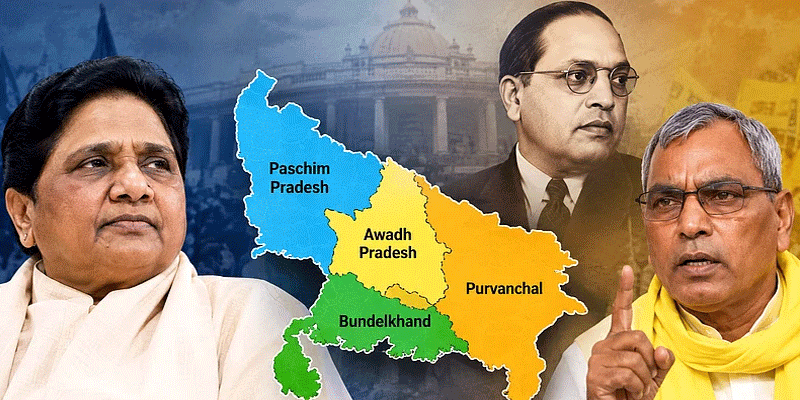
The idea is not new. In 2011, the Mayawati government passed a resolution proposing four states—Purvanchal, Bundelkhand, Awadh Pradesh and Paschim Pradesh—and forwarded the proposal to the Centre. However, the initiative did not progress into a parliamentary reorganisation process.
Supporters have traditionally argued that Uttar Pradesh is too large and diverse to be administered efficiently as a single unit. They point to regional disparities involving employment, infrastructure, migration, drought, water availability and industrial development.
Critics, however, note that creating smaller states does not automatically resolve developmental problems. New administrations would require substantial institutional, financial and infrastructure arrangements, while disputes over resources, boundaries, government employees and revenue-sharing could become major challenges.
Caste Census Adds a New Political Dimension
Rajbhar’s latest intervention is particularly significant because he has tied state reorganisation to the caste census and the demand for greater representation within the 27% OBC quota. His remarks come as Uttar Pradesh approaches the 2027 Assembly election, giving the statehood issue an additional electoral dimension.
Congress leader Ajay Rai, while responding to Rajbhar’s remarks, questioned the political formulation and said his party's position on dividing Uttar Pradesh would require consultation with its national leadership.
What the Constitution Requires
Under Article 3 of the Constitution, Parliament has the power to create new states, alter their boundaries or change their names. A Bill requires the President’s recommendation and, where applicable, must be referred to the concerned state legislature for its views. Those views, however, are not binding on Parliament.
Therefore, Rajbhar’s statement by itself does not constitute a government decision or begin the constitutional process.
From Political Slogan to Constitutional Reality
The renewed four-state debate reflects a combination of longstanding regional aspirations, demands for administrative decentralisation and contemporary questions of caste representation. Yet there remains a substantial gap between a political proposal and actual state reorganisation.
For now, Uttar Pradesh remains one state. Whether the latest demand develops into a formal political and constitutional initiative will depend on decisions by the state government, the Union government and ultimately Parliament. Until then, the “four Uttar Pradeshes” idea is best understood as a revived political proposition rather than an announced government plan.
(With agency inputs)