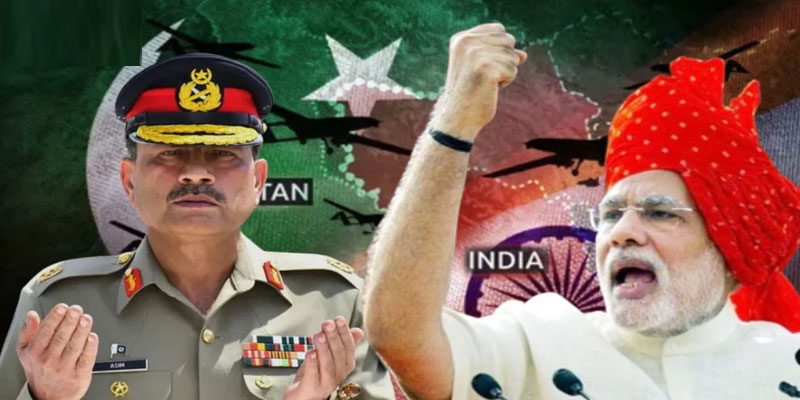
India and Pakistan were engaged in a conflict in May this year after New Delhi launched Operation Sindoor against terror organisations breeding in Pakistan and Pakistan-Occupied Kashmir. The attack was launched by India in retaliation to the killing of 26 civilians by terrorists in Pahalgam.
A major American think tank, the Council on Foreign Relations (CFR), has warned in its report that a “war” could break out between India and Pakistan in 2026. According to the think tank, the primary reason for a potential armed conflict between the two countries could be the “rising terrorist activities.” Citing a survey of US foreign policy experts, the alarming report states that the Trump administration has tried to resolve the disputes between New Delhi and Islamabad.
Notably, India and Pakistan were engaged in a conflict in May this year after New Delhi launched Operation Sindoor against terror organisations breeding in Pakistan and Pakistan-Occupied Kashmir. The attack was launched by India in retaliation to the killing of 26 civilians, mostly tourists, at the hands of Pakistan-backed terrorists in Jammu and Kashmir’s Pahalgam.
The locations targeted by India were key command centres of Jaish-e-Mohammed (JeM) and Lashkar-e-Taiba (LeT), responsible for major attacks like Pulwama (2019) and Mumbai (2008). More than 100 terrorists were killed in the attack.
In retaliation, Pakistan attempted strikes on Indian military bases over the next three days—May 8, 9, and 10. Reacting to this, India launched missile and drone attacks, targeting key military establishments of Pakistan.
After four days of intense cross-border drone and missile exchanges, both countries agreed to de-escalate and end hostilities on May 10. The ceasefire happened after DGMO-level talks between the two nations on Pakistan’s request.
Pakistan confirms damage to Nur Khan Air Base
Pakistan on Saturday officially acknowledged that one of its prominent military installations had been hit during Indian missile strikes as part of Operation Sindoor. The admission marked a rare deflection from Islamabad’s usual stance of denying or minimising the impact of Indian military actions.
During a press briefing, Pakistan’s Foreign Minister and Deputy Prime Minister Ishaq Dar confirmed that the Nur Khan Air Base, located in Rawalpindi’s Chakala area, was hit by Indian missiles. He further stated that the attack resulted in damage to the base and injuries among the personnel stationed there.
"They (India) send drones towards Pakistan. In 36 hours, at least 80 drones were sent... We were able to intercept 79 drones out of 80, and only one drone damaged a military installation and personnel were also injured in the attack," he said.