
A Call for Synchronised Forces in a Changing Battlefield
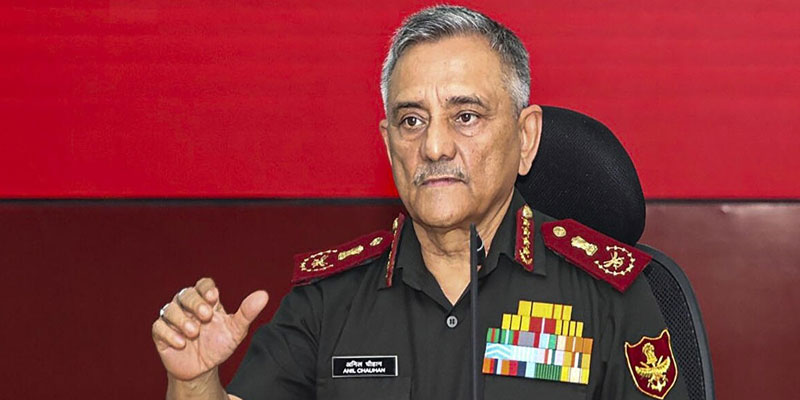
India’s Chief of Defence Staff, Anil Chauhan, has issued a clear and forward-looking directive to the armed forces: prepare for future versions of Operation Sindoor. Speaking near the India–China border, he stressed the urgent need for seamless integration across all military domains. His remarks reflect a shift in strategic thinking, where coordination between land, air, sea, cyber, and space is no longer optional but essential. As threats evolve rapidly, the emphasis is now on building a unified, agile, and technologically advanced fighting force.
Operation Sindoor: A Template for Modern Warfare
Operation Sindoor, launched in response to the April 2025 Pahalgam terror attack, is being positioned as a model for future conflicts. Unlike traditional wars defined by direct confrontation, this operation demonstrated a “non-contact” and “non-linear” approach. It integrated multiple domains—including cyber and electromagnetic spectrum operations—while relying heavily on deception, speed, and precision.
Rather than focusing solely on physical assets, the operation highlighted the importance of narrative control and psychological impact. This marked a departure from conventional doctrines and underscored the growing role of information warfare and strategic messaging in modern conflicts.
The Changing Nature of Global Threats
General Chauhan emphasized that future wars will look fundamentally different from those of the past. Rapid advancements in technologies such as artificial intelligence, quantum computing, hypersonic weapons, and robotics are transforming the battlefield. These innovations are increasing the speed, scale, and unpredictability of warfare.
In this context, the concept of “convergence warfare” becomes critical—where multiple technologies and domains operate simultaneously and in coordination. The challenge lies not only in acquiring advanced systems but in integrating them effectively with existing platforms, such as tanks and artillery, through robust communication networks.
Integration as the Core of Military Readiness
A central theme of Chauhan’s address was the need for deep integration across the armed forces. While each service continues to strengthen its traditional capabilities, the real advantage lies in harmonizing these strengths into a cohesive whole. The proposed theatre command structure is a key step in this direction, aiming to unify command and control for faster and more coordinated responses.
Additionally, the development of specialized units for drones, electronic warfare, and unmanned systems reflects a shift toward future-ready capabilities. Joint training exercises and shared operational doctrines are expected to enhance coordination and improve decision-making speed in complex battle scenarios.
Situational Awareness: The Decisive Edge
One of the most critical factors in future warfare, according to Chauhan, is situational awareness. The ability to gather, process, and act on real-time information across multiple domains will determine success on the battlefield. Enhanced surveillance, data fusion, and networked communication systems are essential to achieving this edge.
Lessons from Operation Sindoor highlight how information dominance and rapid decision-making can outweigh sheer firepower. In high-speed conflicts, the side that understands the battlefield better—and faster—will hold the advantage.
Building Forces for Tomorrow’s Wars
General Chauhan’s call to prepare for future iterations of Operation Sindoor reflects a broader transformation in India’s defence strategy. The focus is shifting from isolated capabilities to integrated, technology-driven warfare that prioritizes speed, coordination, and adaptability. As geopolitical uncertainties grow and conflicts become more complex, India’s ability to evolve its military doctrine will be crucial. Preparing for the next “Op Sindoor” is not just about readiness—it is about redefining how wars are fought and won in the modern era.
(With agency inputs)