PoK Crackdown Exposes Pakistan’s Kashmir Governance Crisis
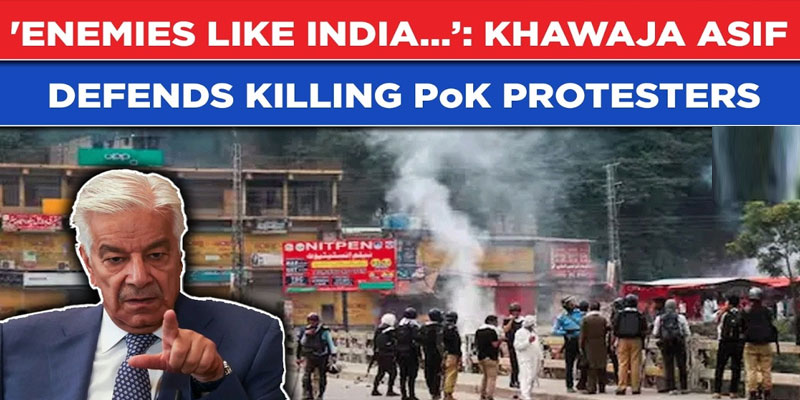
Asif Defends Killings, Labels PoK Protesters ‘Enemies Like India’
Pakistan's Defence Minister Khawaja Asif has triggered widespread controversy after defending the killing of civilians during protests in Pakistan-occupied Kashmir (PoK), declaring that the protesters were "enemies like India." His remarks came after Pakistani security forces allegedly opened fire on demonstrators led by the Joint Awami Action Committee (JAAC) during the recent regional assembly elections, with JAAC claiming that 14 protesters were killed and more than two dozen others injured.
The statement has intensified criticism of Islamabad's handling of dissent in PoK, raising fresh questions about democratic rights, human rights and Pakistan's long-standing claim that the region enjoys autonomous self-governance.
Why PoK Erupted in Protest
The current unrest did not emerge overnight. Since early June 2026, PoK has witnessed sustained protests led by the Joint Awami Action Committee (JAAC), a coalition comprising traders, lawyers, students and civil society groups.
The movement initially focused on several long-standing grievances, including:
· High electricity tariffs despite PoK generating hydropower.
· Rising inflation and worsening economic conditions.
· Alleged political marginalisation by Islamabad.
· Claims of manipulation of reserved seats in the PoK Legislative Assembly.
· Demands for greater administrative autonomy and transparency.
Instead of engaging in dialogue, Pakistani authorities responded by banning JAAC under anti-terrorism laws, announcing rewards for the arrest of its leaders and deploying paramilitary forces across Muzaffarabad, Rawalakot and other towns. The crackdown transformed an economic protest into a broader political movement questioning Islamabad's control over the region.
Election Violence Deepens Questions Over Democratic Credibility
The crisis escalated during the July 2026 PoK Legislative Assembly elections. JAAC had called for an election boycott, alleging that the electoral process was manipulated and lacked credibility.
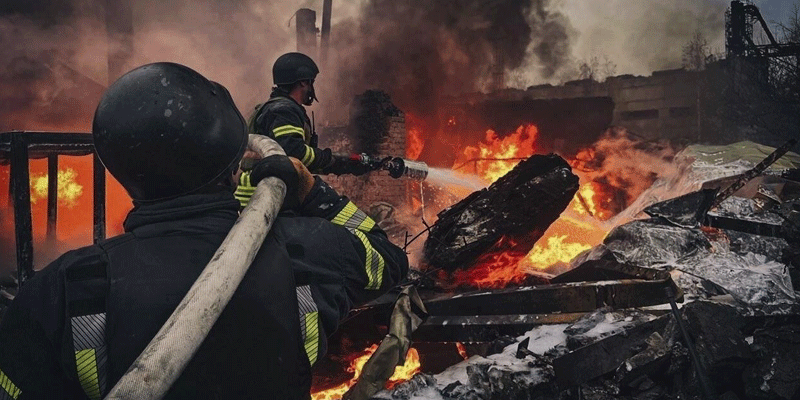
According to protest leaders, security forces opened fire on demonstrators during polling, resulting in one of the deadliest incidents witnessed in PoK in recent years. The violence reportedly continued during funeral processions and post-election protests.
Khawaja Asif's subsequent television interview further inflamed tensions when he equated protesting civilians with India's adversarial role and ruled out negotiations.
Analysts believe the statement reflects three important trends:
· It portrays legitimate public grievances as national security threats.
· It blurs the distinction between peaceful political dissent and external hostility.
· It reinforces the dominance of Pakistan's security establishment over civilian political processes in PoK.
Rather than calming tensions, the remarks have strengthened perceptions that Pakistan relies increasingly on coercion rather than democratic engagement in the disputed territory.
Growing Questions Over Pakistan's Governance Model
The latest violence has intensified scrutiny of Pakistan's governance framework in PoK.
Islamabad has consistently projected Pakistan-occupied Kashmir as a self-governing region enjoying democratic freedoms. However, repeated allegations of political interference, restrictions on civil society, use of anti-terror laws against activists and the deployment of security forces during protests have raised concerns among observers about the extent of genuine political autonomy.
The unrest also comes at a time when Pakistan is grappling with economic instability, political uncertainty and declining public confidence in state institutions, adding another layer of pressure on the country's security establishment.
Implications for India
The developments carry several strategic implications for India:
· Diplomatic narrative: The crackdown strengthens India's position in highlighting alleged human rights concerns and democratic deficits in Pakistan-occupied Kashmir before the international community.
· Kashmir discourse: India can draw comparisons between governance and electoral processes in Jammu & Kashmir and the reported unrest and restrictions in PoK, reinforcing its own political narrative.
· Changing public sentiment in PoK: The emergence of organised civil society movements such as JAAC indicates that sections of the local population are increasingly expressing dissatisfaction with Islamabad's administration.
· Security concerns: Heightened tensions and increased militarisation in PoK may raise the possibility of cross-border incidents or attempts to divert attention from internal unrest, requiring continued vigilance along the Line of Control.
· Strategic leverage: Pakistan's internal challenges in PoK could weaken its diplomatic position on the Kashmir issue by drawing greater international attention to governance-related concerns within the territory it administers.
Latest Developments
Following the election-related violence, security deployments across several parts of PoK have reportedly remained heavy, while protests continue in pockets despite restrictions. JAAC leaders have reiterated demands for justice for those killed, withdrawal of cases against activists and restoration of democratic rights.
Meanwhile, Khawaja Asif's remarks have become the focal point of political debate, with critics arguing that equating civilian protesters with an external adversary reflects an increasingly securitised approach to internal political dissent rather than a willingness to address legitimate public grievances.
A Crisis That Extends Beyond the Protests
The killing of protesters and Khawaja Asif's assertion that PoK demonstrators are "enemies like India" have transformed a regional protest into a larger political and diplomatic issue. The episode has exposed deep public discontent, intensified questions about democratic governance in Pakistan-occupied Kashmir and highlighted the growing reliance on security measures to manage political dissent.
For India, the developments offer an opportunity to reinforce its long-standing position on governance and human rights in PoK while closely monitoring the evolving security environment along the Line of Control. More importantly, the unfolding crisis suggests that the real challenge confronting Islamabad is no longer merely managing a disputed territory, but addressing the aspirations and grievances of the very people it claims to represent.
(With agency inputs)