Congress Targets Government Over Paper Leaks and Accountability
Alleging that India's education system has become a rigged system, Congress MP and Leader of Opposition Rahul Gandhi launched a fresh attack on the Centre, claiming that 152 paper leaks have occurred over the past decade without a single conviction. Linking the controversy to the alleged NEET-UG 2026 paper leak, Rahul accused the government of failing millions of students and demanded the resignation of Union Education Minister Dharmendra Pradhan.
His remarks come amid intensifying nationwide protests over examination integrity and have further sharpened the political battle over the NEET controversy.
Rahul Gandhi and the NEET Protest Campaign
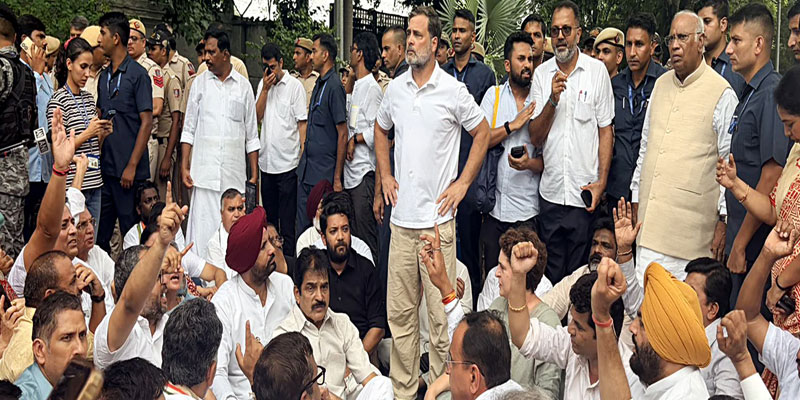
Rahul Gandhi has been at the forefront of the Opposition's campaign against the alleged NEET paper leak. A day before his latest remarks, he was detained by Delhi Police along with several Congress leaders during a sit-in near Prime Minister Narendra Modi's residence.
The protest followed clashes during the Cockroach Janata Party (CJP)'s Sansad Chalo march in Delhi, where demonstrators demanded accountability for the alleged examination irregularities and sought the resignation of Dharmendra Pradhan. Rahul has since positioned the issue as one of governance, transparency and students' rights rather than merely an administrative lapse.
'Rigged System' Charge Against the Government
Addressing supporters, Rahul described India's examination system as fundamentally compromised.
His key allegations included
· 152 paper leaks over the past decade.
· 7.5 crore students allegedly affected.
· Zero convictions despite repeated examination scandals.
Displaying a graphic titled Paper Leak Epidemic, Rahul argued that repeated leaks have destroyed students' faith in merit-based opportunities and accountability.
He also reiterated earlier allegations that questions from the NEET-UG 2026 examination were circulated on WhatsApp before the test, describing the examination process as an auction where question papers were allegedly sold.
The Reality Behind the Numbers
While Rahul's figures have become a powerful political slogan, investigations present a more nuanced picture.
Available reports indicate
· Numerous examination leaks have occurred across the country over the years.
· Investigations have resulted in over 1,600 arrests and hundreds of charge sheets.
· A limited number of convictions have taken place, though the overwhelming majority of cases remain pending in courts.
The government has also enacted stricter anti-paper leak legislation prescribing
· Jail terms of five to ten years.
· Minimum fines of ₹1 crore for organised examination leak rackets.
However, slow investigations and prolonged trials have reinforced public perceptions that accountability remains inadequate.
Political Focus on Dharmendra Pradhan
Rahul Gandhi continues to insist that the alleged failure of the NEET examination warrants ministerial accountability.
According to the Congress leader
· The issue affects nearly 22 lakh NEET aspirants.
· The controversy reflects systemic governance failures.
· The Education Minister must accept moral responsibility and resign.
By linking NEET with other recruitment and entrance examination controversies, Rahul seeks to portray the problem as institutional rather than isolated.
A Debate Over Merit, Governance and Public Trust
The controversy extends beyond one examination. Repeated allegations of paper leaks have raised broader concerns over the credibility of India's competitive examination system, the effectiveness of investigative agencies and public confidence in merit-based selection. While the government maintains that legal action is underway and reforms have been introduced to curb examination fraud, the Opposition argues that delayed justice has deepened public distrust. As the political confrontation intensifies, the NEET controversy has evolved into a larger debate over educational governance, institutional accountability and the future of millions of students whose aspirations depend on the integrity of India's examination system.
(With agency inputs)