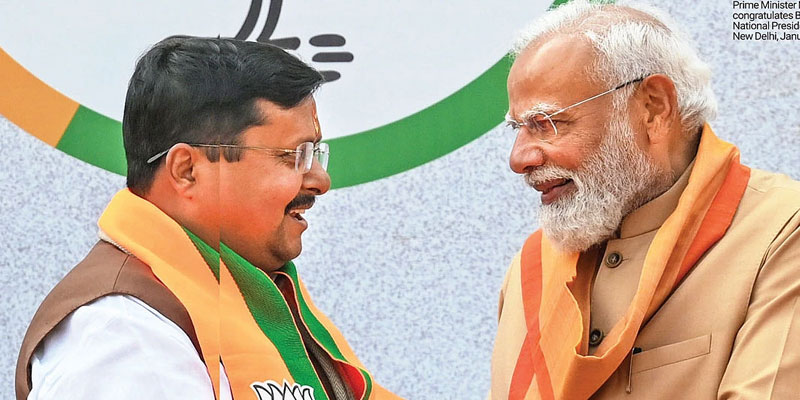
The Bharatiya Janata Party (BJP) has unveiled its new national office-bearers under party president Nitin Nabin, marking one of the biggest organisational reshuffles ahead of crucial state Assembly elections and the 2029 Lok Sabha roadmap. Former Rajasthan Chief Minister Vasundhara Raje Scindia and former BJP national general secretary Ram Madhav have been appointed national vice-presidents, while former Union minister Smriti Irani returns to the party's core leadership as a national general secretary. The overhaul reflects the BJP's attempt to combine experienced leadership with a younger organisational team while expanding the role of women within the party structure.
A Strategic Organisational Reset
The reshuffle comes months after Nitin Nabin assumed the BJP's national presidency in January 2026. Rather than making minor adjustments, the party has opted for a broader restructuring that seeks to strengthen its election machinery before upcoming state polls and build a leadership framework for the next national electoral cycle.
Party insiders describe the new team as an effort to balance continuity with generational renewal, ensuring that experienced leaders remain influential while emerging faces gain greater organisational responsibility.
Top Leadership: Who Got the Key Roles?
The newly announced team places several heavyweight leaders in pivotal positions.
Among the prominent appointments:
· Vasundhara Raje Scindia – National Vice-President
· Ram Madhav – National Vice-President
· Smriti Irani – National General Secretary
The broader structure reportedly includes around 10 national vice-presidents and eight general secretaries, creating a leadership layer responsible for organisational coordination, political messaging and state-level oversight.
Several other senior leaders, including Anurag Thakur, Satish Poonia, Dharmendra Pradhan, Poonam Mahajan and regional organisers, are also expected to play significant roles in the expanded national setup.
Balancing Regions, Experience and Youth
One of the defining features of the reshuffle is its emphasis on regional representation.
The BJP appears to have crafted the new team to strengthen its presence in states facing upcoming Assembly elections while accommodating diverse caste, community and social-group representation.
At the same time, the party is reportedly reducing dependence on the previous organisational structure, with only a limited number of existing general secretaries expected to continue in their earlier roles.
Bigger Role for Women and Young Leaders
The new organisational structure also reflects the BJP's recent constitutional amendment reserving 33% of national office-bearer positions for women.
The party is also pushing for younger leadership, encouraging state youth wing presidents to remain below 35 years of age, signalling an effort to cultivate future leadership from the grassroots upward.
Electoral Strategy Behind the Reshuffle
The timing is significant. With politically crucial Assembly elections approaching—including in states like Uttar Pradesh and Punjab—the BJP is seeking tighter coordination between its national leadership and state organisations.
The first meeting of Nitin Nabin's newly constituted team is scheduled for August 22, where regional responsibilities, campaign priorities and organisational tasking are expected to be finalised.
Building the Roadmap Beyond Immediate Elections
The new national team represents more than an internal reshuffle—it reflects the BJP's long-term organisational strategy. By combining senior political veterans with emerging leaders and expanding women's participation, the party is attempting to strengthen both its immediate electoral preparedness and its future leadership pipeline. How effectively this revamped structure translates into coordinated campaigning and stronger grassroots mobilisation will shape not only the upcoming Assembly elections but also the BJP's broader Mission 2029 ambitions.
(With agency inputs)