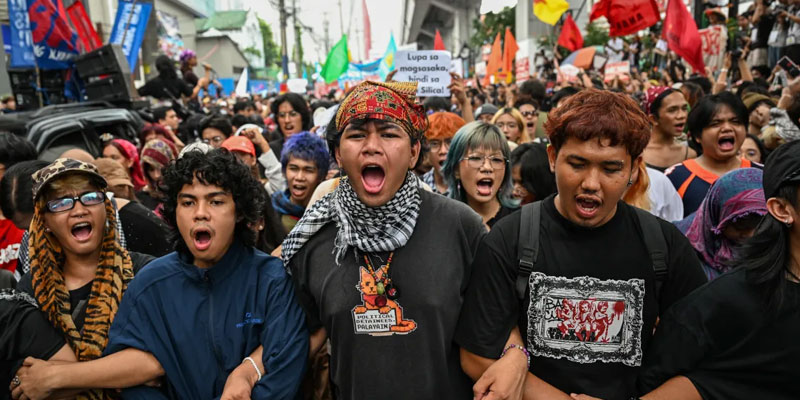
The burning of an effigy of US President Donald Trump by protesters in the Philippines has brought international attention to growing opposition against the proposed US-backed Pax Silica technology initiative. Ahead of Trump’s arrival in Manila for the 49th ASEAN Summit, Indigenous Aeta communities, farmers, students and environmental activists demonstrated against a planned semiconductor and advanced-manufacturing hub in Tarlac province. Their concerns extend beyond foreign investment, highlighting questions of ancestral land rights, environmental protection, national sovereignty and the Philippines’ growing involvement in the US-China technology rivalry.
Flaming-Arrows Protest Sends Political Message
On November 14, protesters assembled at the University of the Philippines Diliman in Quezon City, where they shot flaming arrows at an effigy of Trump carrying the words “Trumplunderer” and “I love Pax Silica”.
The demonstration was organised ahead of Trump's November 17 visit to Manila and reflected opposition to the proposed industrial project. Participants included Aeta community representatives, farmers, students and environmental organisations.
Similar demonstrations were reported in Manila, Baguio, Ilocos Sur and Cebu, with protesters raising slogans such as “Reject Pax Silica” and “Trump Out”. The mobilisation connected local land-rights concerns with wider objections to American strategic influence in the region.
What Is Pax Silica and Why Does It Matter?
Pax Silica is a US-led initiative launched in December 2025 to strengthen international supply chains for strategically important industries, including:
· Semiconductors and advanced chip manufacturing.
· Artificial intelligence and computing infrastructure.
· Critical minerals and energy resources.
· Advanced manufacturing and emerging technologies.
For Washington, the initiative supports efforts to diversify supply chains and reduce dependence on China. For Manila, it offers the prospect of foreign investment, employment opportunities and a stronger position in semiconductor assembly, testing, packaging and mineral processing.
Indigenous Land Rights and Environmental Concerns
The strongest opposition comes from Aeta Indigenous communities and small farmers who fear losing ancestral territories, agricultural land and traditional livelihoods.
According to Human Rights Watch, the proposed development could displace hundreds of Indigenous residents and farmers. Communities have also raised concerns about:
· Loss of ancestral territories, burial grounds and culturally significant locations.
· Reduced access to agricultural land and traditional water sources.
· Environmental damage from large-scale industrial activity and mineral processing.
· Inadequate consultation and protection of Indigenous land rights.
Aeta leader Apung Petronila Capiz-Munoz has described the development as a violation of community rights. Activists are demanding meaningful consultation and free, prior and informed consent before the project proceeds. The Philippine government, however, has maintained that affected communities should not be displaced.
Latest Developments: Agreement Remains Unsigned
Protests continued during Trump's November 17–18 visit, with demonstrations in Manila and confrontations between protesters and police. Human Rights Watch reported that at least 245 people were arrested or detained during the protests, raising additional concerns about freedom of peaceful assembly.
On November 18, President Ferdinand Marcos Jr. and US Ambassador Lee Lipton confirmed that the Pax Silica framework agreement would not be signed during Trump's visit. However, discussions on the initiative remain open.
Technology Must Not Override Community Rights
The controversy surrounding Pax Silica illustrates the growing intersection of technological competition, international geopolitics and local land rights. While semiconductor manufacturing and critical-mineral processing could create economic opportunities for the Philippines, their development also carries social and environmental responsibilities. Manila faces the challenge of balancing strategic cooperation with Washington against the legitimate concerns of its Indigenous population and farming communities. Without transparent agreements, meaningful consultation, fair compensation and enforceable environmental safeguards, the proposed technology hub risks deepening social divisions instead of delivering inclusive development.
(With agency inputs)