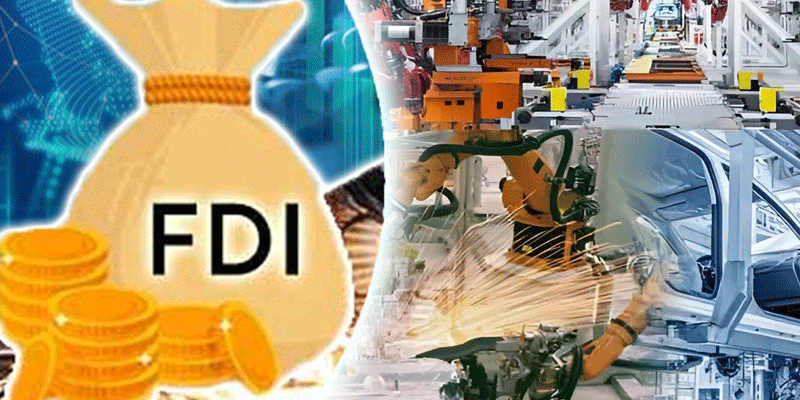
India attracted USD 843 billion in cumulative foreign direct investment between FY2014-15 and FY2025-26, including a record USD 94.53 billion in FY2025-26, highlighting the scale of investment India has drawn over the past 12 years. The figures come as the government marks another milestone for Make in India, with the investment story increasingly shifting from broad liberalisation towards targeted manufacturing incentives and infrastructure-led industrial development.
From Make in India to PLI-Led Manufacturing
Launched in September 2014, Make in India sought to position the country as a global manufacturing, investment and innovation hub. Over time, the policy framework expanded through FDI liberalisation, ease-of-doing-business reforms, infrastructure development and measures aimed at integrating India into global supply chains.
These include:
· Large-scale electronics and IT hardware
· Pharmaceuticals and medical devices
· Automobiles and auto components
· Telecom and networking products
· Solar PV modules and advanced batteries
· Specialty steel and textiles
· White goods, food processing and drones
The objective is not simply to attract capital, but to link incentives with incremental production, exports, employment and domestic manufacturing capacity.
PLI Converts Investment into Production
The latest government data indicates that PLI schemes had attracted more than ₹2.40 lakh crore in actual investment by March 2026. They generated more than ₹22.66 lakh crore in production and sales, over ₹15.20 lakh crore in exports, and more than 14.15 lakh direct and indirect jobs.
Electronics has emerged as one of the most visible examples. Government data says domestic mobile-phone production has risen substantially since the scheme began, while imports have fallen sharply. Pharmaceuticals, automobiles, specialty steel and solar manufacturing have also recorded significant investment under the programme.
Infrastructure Becomes the Next Investment Driver
Incentives alone cannot create globally competitive manufacturing ecosystems. India is therefore simultaneously expanding industrial infrastructure through programmes such as the National Industrial Corridor Development Programme, alongside multimodal connectivity initiatives.
The broader strategy is to provide investors with industrial locations offering logistics, utilities, connectivity and other facilities required for large-scale production.
This matters because India's ability to attract the next wave of FDI will increasingly depend not merely on incentives, but on speed, infrastructure quality and ease of operating across states.
The Next Challenge: From Assembly to Value Addition
The FDI numbers demonstrate growing investor interest, but the composition of investment remains crucial. Electronics, automobiles and selected sectors have benefited strongly, while India still needs deeper domestic supply chains, stronger component manufacturing and greater research and development.
The government has itself stressed the need for quality skills, infrastructure and export competitiveness as the PLI programme evolves.
FDI Momentum Must Become Industrial Depth
India's USD 843-billion FDI journey represents more than a headline investment figure. It reflects a gradual evolution from Make in India to a more targeted industrial strategy built around incentives, infrastructure and global supply-chain integration.
The next test is whether this capital creates deep manufacturing ecosystems rather than isolated assembly hubs. Sustained FDI will ultimately depend on competitive logistics, skilled manpower, domestic value addition, technological innovation and predictable policy. If those elements advance together, India's investment surge can translate into a durable manufacturing base and stronger integration with global production networks.
(With agency inputs)