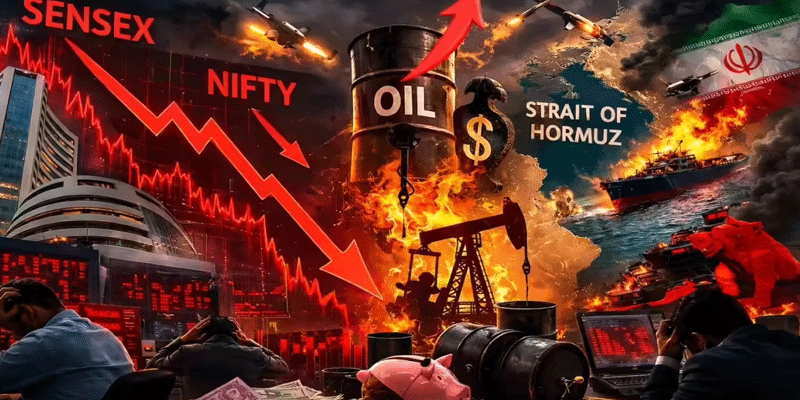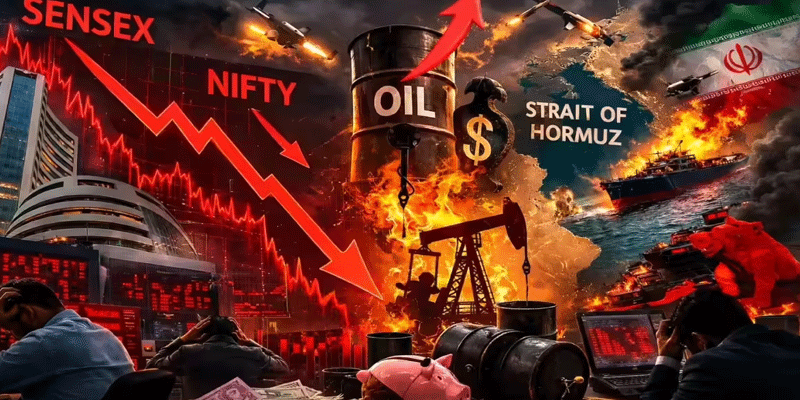
The warning from Friday’s market bloodbath was unmistakable: escalating West Asia tensions pushed Brent crude above $108 a barrel, sending the Sensex down as much as 742 points and dragging the Nifty 50 below 23,250. By 9:35 a.m., the Nifty had fallen 0.92% to 23,261.7, while the Sensex was down 0.84% at 74,272.61. Both benchmarks touched their lowest levels since June 11, reflecting rising anxiety over energy costs, inflation and economic growth.
Selling Spreads Across the Market
The decline was broad-based, with 15 of 16 major sectoral indices trading lower. Mid-cap and small-cap stocks fell 1.4% and 1.2%, respectively, while financials declined 1.4%, autos 1.3% and metals 2.8%. Realty and metals were among the biggest casualties as investors reduced exposure to economically sensitive businesses.
West Asia Adds a Geopolitical Premium
The immediate catalyst was the worsening conflict involving Iran, the United States and their regional allies. Iran-aligned Houthi forces reportedly seized Yemen’s Mocha and advanced towards strategic islands near the Bab el-Mandeb Strait, while tanker attacks around the Strait of Hormuz intensified.
The possibility of disruption across both corridors has pushed a geopolitical risk premium into crude prices. Brent moved above $108, while WTI crossed $103. For India, the world’s third-largest oil importer, sustained crude prices above $100 could significantly enlarge the import bill, pressure the rupee and complicate inflation management.
How Expensive Oil Reaches Every Sector
The economic transmission is wide. Higher crude can widen the current-account deficit, increase transportation and logistics costs and raise expenses for aviation, chemicals and manufacturing. Companies unable to pass those costs to consumers face shrinking margins, while households can experience weaker purchasing power if fuel and food prices rise.
Higher inflation could also restrict the scope for interest-rate reductions, undermining expectations of easier monetary policy. Upstream producers such as ONGC and Oil India can benefit from stronger crude realisations, but airlines, automobile companies, metals, cement producers and financial stocks remain more exposed to the downside.
Global Bond Yields Compound the Pressure
The market’s weakness was reinforced by rising global yields. The US 10-year Treasury yield approached 5%, increasing the attractiveness of dollar assets and potentially encouraging foreign investors to reduce emerging-market exposure. Indian government bonds also weakened, with the benchmark 10-year yield moving above 7%.
The combination of expensive oil, a stronger dollar and higher borrowing costs creates pressure across both equity and debt markets.
A Market Correction with A Larger Economic Warning
The latest decline extended a prolonged period of caution, with the Sensex and Nifty heading towards their fifth consecutive weekly fall. Investors are now watching crude prices, developments around Hormuz and the Red Sea, foreign institutional flows, the rupee and global inflation signals.
A rapid geopolitical de-escalation could trigger a market recovery. But prolonged disruption would threaten growth, inflation and corporate earnings simultaneously. Friday’s sell-off is therefore more than a correction—it is a reminder that India’s economic resilience remains closely tied to the stability of global energy routes.
(With agency inputs)