India Has ‘Strong Political Weight’, Says Palestinian Envoy
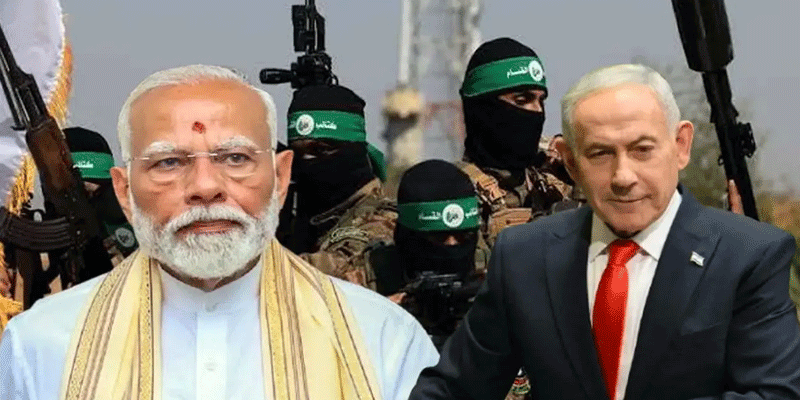
Palestinian Ambassador to India Abdullah M. Abu Shawesh has publicly backed New Delhi’s long-standing demand for a permanent seat on the United Nations Security Council, saying India possesses “strong political weight” and can contribute more decisively to global diplomacy. His remarks came in mid-August 2026, after a senior Indian delegation visited Palestine and held discussions with Palestinian officials amid the continuing humanitarian crisis in Gaza. The endorsement adds diplomatic significance to India’s UNSC campaign while placing greater expectations on New Delhi to use its influence to support Palestinian statehood and a negotiated two-state solution.
India’s UNSC Ambition and Palestine’s Support
India’s campaign for permanent UNSC membership is rooted in its growing economic and geopolitical weight, extensive UN peacekeeping contribution and role as a prominent voice of the Global South. As part of the G4 with Brazil, Germany and Japan, India has consistently demanded Security Council reform to reflect present-day global realities.
Palestine’s support fits naturally within this diplomatic framework. India recognised Palestine in 1988 and has consistently supported Palestinian self-determination at international forums. At the same time, New Delhi has developed strong strategic relations with Israel, giving it a distinctive position that Shawesh believes could be useful in advancing dialogue.
Talks, Diplomatic Engagement and Strategic Expectations
The Palestinian envoy’s comments came against the backdrop of growing Indian-Palestinian diplomatic engagement. Discussions between the Indian delegation and Palestinian officials focused on the grave humanitarian situation in Gaza, India’s continued support for Palestinian aspirations and the importance of preserving the two-state framework.
For Palestine, India represents an important diplomatic bridge. New Delhi maintains relations with Israel while retaining longstanding political credibility across much of the Global South. Shawesh’s appeal for India to use its relationship with Israel therefore reflects an expectation that India can contribute to de-escalation without abandoning its independent foreign-policy approach.
The engagement also reinforces India’s broader development partnership with Palestine, including capacity-building and assistance programmes, alongside political support for Palestinian statehood.
The Balancing Act for New Delhi
The endorsement is diplomatically useful but also presents India with a delicate challenge. Its defence, technology, agriculture and counter-terrorism cooperation with Israel has expanded substantially. At the same time, India cannot ignore the Palestinian humanitarian crisis or its historical commitment to Palestinian self-determination.
New Delhi’s preferred approach has therefore been calibrated: support humanitarian assistance, advocate dialogue and reiterate commitment to a negotiated two-state solution, while avoiding positions that could damage its strategic relationship with Israel.
Shawesh’s appeal effectively asks India to convert this diplomatic balance into constructive influence.
A Significant Voice for India’s UNSC Campaign
The Palestinian endorsement strengthens India’s argument that UNSC reform enjoys support among developing and conflict-affected nations. It also contrasts with opposition from countries such as Pakistan, which has questioned India’s permanent-membership credentials.
Yet support alone cannot overcome resistance from existing permanent members and competing geopolitical interests. India will need sustained backing from a broad coalition of countries.
Diplomatic Convergence Must Become Strategic Influence
Palestinian Envoy Shawesh’s endorsement represents more than a symbolic compliment—it reflects a diplomatic convergence between Palestine’s search for credible international influence and India’s ambition for a larger multilateral role. For New Delhi, the opportunity lies in demonstrating that permanent UNSC membership would not merely reflect India's power, but its capacity to build bridges, defend multilateralism and contribute meaningfully to conflict resolution.
India’s challenge now is to turn that diplomatic goodwill into sustained global support while maintaining its carefully calibrated relations with both Israel and Palestine.
(With agency inputs)