India Strengthens Strategic Grip Over Siliguri Corridor
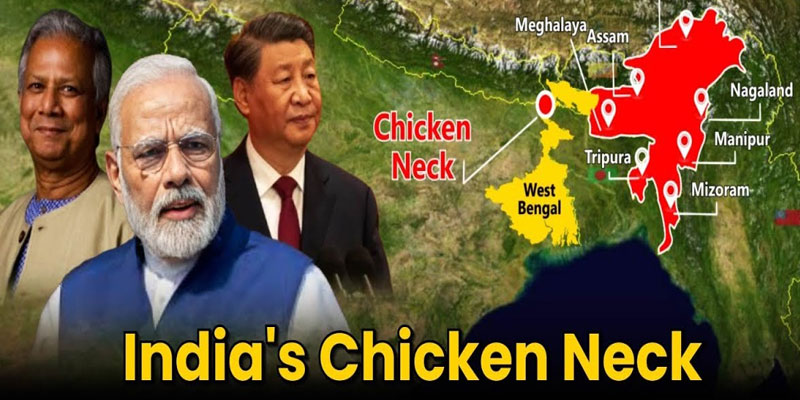
India is reinforcing security and connectivity around the strategically vital Siliguri Corridor — widely known as the “Chicken’s Neck” — by transferring several crucial border-area highways in West Bengal to central infrastructure agencies. The newly installed BJP government in the state has approved, in principle, the transfer of seven important highway stretches to the National Highways Authority of India (NHAI) and the National Highways & Infrastructure Development Corporation Limited (NHIDCL). The decision breaks a prolonged administrative deadlock and is expected to accelerate road expansion and modernization in one of India’s most sensitive strategic zones.
Why the “Chicken’s Neck” Is Strategically Crucial
The Siliguri Corridor is one of India’s most geopolitically sensitive regions. At its narrowest point, the corridor is only around 22 kilometres wide, forming the sole land connection between mainland India and the eight northeastern states — Assam, Arunachal Pradesh, Meghalaya, Mizoram, Manipur, Nagaland, Tripura, and Sikkim.
Its strategic importance lies not only in geography but also in vulnerability. Any major disruption in the corridor could sever critical road, rail, and military supply routes to the Northeast, potentially isolating millions of people and weakening India’s defence preparedness in the region.
The corridor is surrounded by strategically significant neighbours. Bangladesh lies to the south, while the sensitive Bhutan and China frontier lies to the north. Given ongoing India-China tensions, particularly after clashes along the Line of Actual Control in recent years, the Siliguri Corridor has become central to India’s long-term military and infrastructure planning.
Which Highways Are Being Handed Over
Under the proposed transfer, major national highway stretches including NH-31, NH-33, and NH-312 will now come under NHAI management. Meanwhile, strategically sensitive stretches near international borders — including Sevok-Coronation Bridge, Hasimara-Jaigaon, and Changrabandha corridors — will be handled by NHIDCL, an agency specializing in infrastructure development in difficult and border-adjacent terrain.
Many of these projects had faced delays due to administrative hurdles and coordination issues between state and central authorities. Their transfer is expected to accelerate widening projects, improve road quality, and ensure better all-weather connectivity across North Bengal and adjoining strategic areas.
Defence and Economic Impact
The move carries major defence implications. Better highways mean faster troop mobilization, quicker transport of heavy military equipment, and more reliable logistical support to India’s northeastern frontier. In a conflict scenario, reducing bottlenecks in the Siliguri Corridor could prove critical for maintaining operational readiness.
Improved connectivity also strengthens India’s broader regional strategy. Enhanced road infrastructure supports trade and tourism links with Bhutan and Nepal while improving civilian movement across North Bengal. Economically, the corridor serves as a gateway to India’s “Act East” policy ambitions and its growing focus on connectivity with Southeast Asia.
Political and Administrative Significance
The decision also reflects a notable shift in Centre-state coordination in West Bengal. The earlier government led by Mamata Banerjee had reportedly delayed the transfer process for years. The current BJP-led administration has aligned more closely with New Delhi’s infrastructure and border-security priorities.
By placing sensitive highway networks directly under central agencies, both Kolkata and New Delhi are signaling a more security-oriented approach to strategic infrastructure management.
Reinforcing India’s Most Vulnerable Strategic Link
The strengthening of infrastructure in the Siliguri Corridor goes beyond road construction; it represents a calculated effort to secure one of India’s most critical geopolitical lifelines. As regional tensions and strategic competition intensify, ensuring the resilience of the Chicken’s Neck has become essential not only for national defence but also for economic integration, regional stability, and India’s broader strategic ambitions in the Indo-Pacific.
(With agency inputs)