A Strategic Shopping List Ahead of Tel Aviv
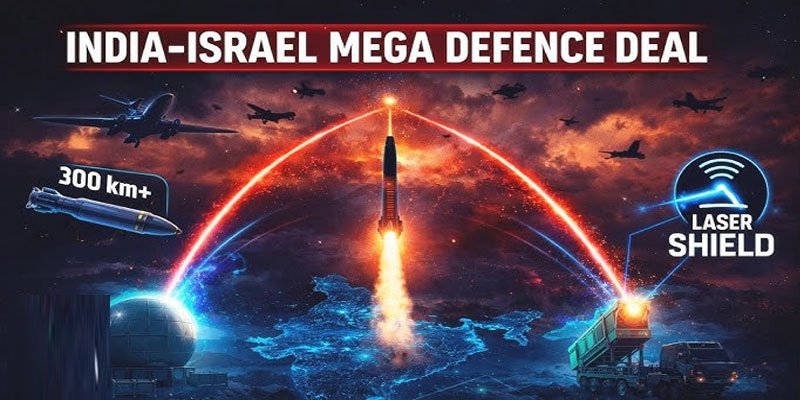
India is preparing to significantly upgrade its air defence and precision strike capabilities as Prime Minister Narendra Modi gears up for a high-stakes visit to Israel in March 2026. Central to the agenda are advanced drones, precision-guided missiles, and cutting-edge directed-energy systems under India’s evolving “Mission Sudarshan Chakra.”
Among the most discussed systems is Israel’s Iron Beam—a 100kW laser platform capable of intercepting drones, rockets, and short-range threats at an estimated cost of just $2 per shot. The system represents a leap over India’s indigenous 30kW Mk-II(A) prototype tested in 2025. If finalized, the deal could anchor a new layer in India’s multi-tiered air defence architecture.
Proven Battlefield Edge and Expanding Arsenal
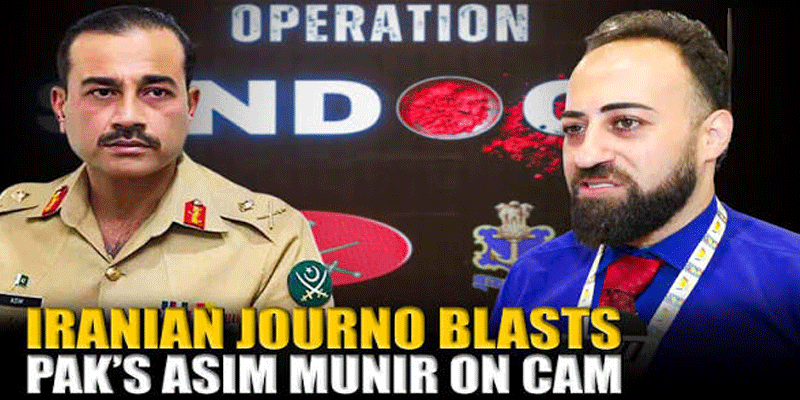
Israeli-origin platforms have already demonstrated their operational value. During Operation Sindoor in 2025, loitering munitions such as Harop and supersonic Rampage missiles were deployed in precision strikes against terror infrastructure. The Heron Mk-II MALE drone, with endurance up to 45 hours and satellite communication capability, is now being considered for tri-service integration, including naval surveillance.
Prospective acquisitions may also include SPICE precision bombs, extended-range Barak systems, and stand-off missiles such as LORA. Co-development initiatives around Arrow and David’s Sling missile defence technologies are reportedly under discussion. With deals potentially worth $6–8 billion, Israel could overtake France as India’s top defence supplier.
Strategic Imperatives: Filling Critical Gaps
India faces an increasingly complex threat environment marked by drone swarms, cruise missiles, and hypersonic advancements from adversaries. While the Defence Research and Development Organisation (DRDO) has made strides, Israeli systems offer scalability, combat-proven reliability, and rapid deployment advantages.
Iron Beam, for instance, would complement India’s S-400 and Akash air defence systems by offering low-cost interception against saturation attacks along the Line of Control (LoC). Transfer-of-technology agreements—similar to the Barak-8 collaboration—could accelerate India’s Atmanirbhar Bharat defence goals, deepening joint R&D and domestic manufacturing through partnerships such as Adani-IAI ventures in Hyderabad.
Impact on India–Pakistan Security Dynamics
These acquisitions are likely to tilt the conventional balance in India’s favor. Enhanced surveillance via Heron drones and precision strike capabilities through Rampage and Harop systems would strengthen India’s deterrence posture against cross-border terror infrastructure. Directed-energy systems could blunt Pakistan’s expanding drone and cruise missile inventory, including Babur variants.
However, strategic asymmetry often triggers countermeasures. Pakistan may accelerate collaboration with China, seeking platforms such as stealth UAVs, advanced air defence lasers, or hypersonic missile systems. The proliferation of loitering munitions and drone swarms on both sides raises risks of rapid escalation under fog-of-war conditions.
India’s layered missile defence, combined with its no-first-use nuclear doctrine, could narrow the operational space for Pakistan’s tactical nuclear options such as Nasr. While this enhances deterrence stability from India’s perspective, it may also push Islamabad toward unconventional or asymmetric responses.
Economic and Diplomatic Dimensions
Beyond security, the acquisitions signal deepening strategic alignment. Israel’s defence exports to India exceeded $5 billion in 2025, underscoring mutual dependence. Joint innovation in AI-driven surveillance, cyber defence, and counter-drone technologies aligns with broader Indo-Pacific and Quad dynamics.
Domestically, large-scale procurement with local assembly components would generate employment and bolster India’s defence industrial base, reducing reliance on traditional suppliers amid geopolitical flux.
Strengthening Shields, Managing Stability
India’s prospective defence acquisitions from Israel reflect a calculated effort to harden its airspace against emerging threats. The move strengthens deterrence, modernizes capabilities, and advances indigenization goals.
Yet technological superiority alone cannot guarantee stability. As India fortifies its defences, parallel diplomatic engagement and confidence-building mechanisms remain essential to prevent escalation. The Modi visit, therefore, represents not just an arms upgrade—but a strategic recalibration at the intersection of technology, deterrence, and regional balance.
(With agency inputs)