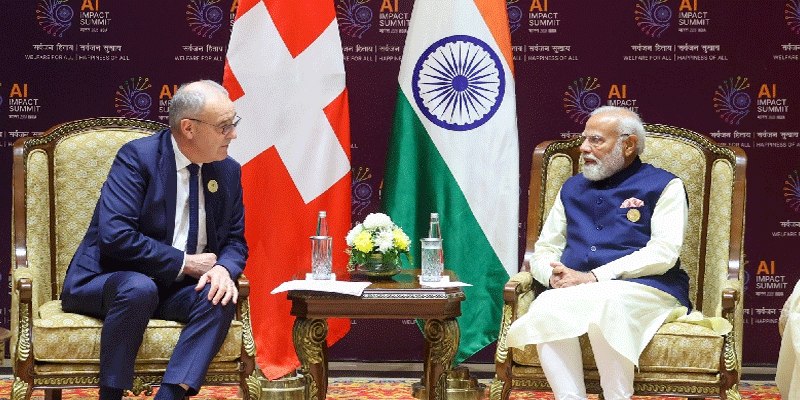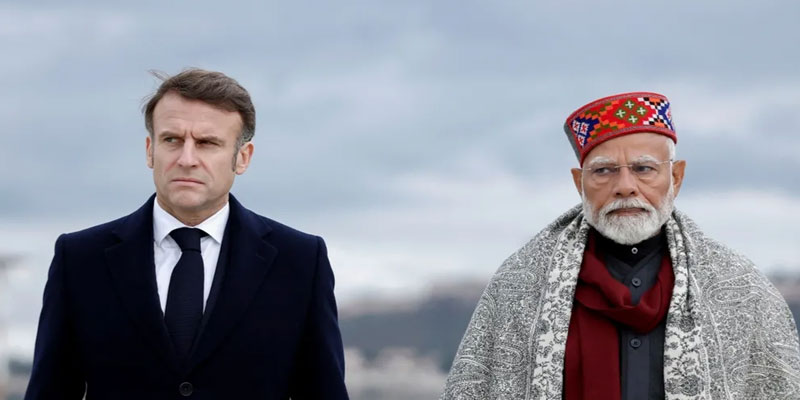
French President Emmanuel Macron will arrive in India on Monday night for a key diplomatic visit that is expected to reinforce the expanding strategic partnership between France and India. During his stay, he will hold a bilateral meeting with Prime Minister Narendra Modi, with both sides seeking to strengthen cooperation across defence, technology, climate action and the Indo-Pacific. The talks are widely viewed as an opportunity to accelerate long-term strategic alignment and implement the ambitious Horizon 2047 roadmap that guides bilateral engagement for the next two decades.
A Timely Strategic Engagement
Macron’s visit comes at a moment of shifting geopolitical equations, marked by renewed great-power competition, supply-chain realignments and technological disruption. India and France have steadily built one of the most stable partnerships among major powers, grounded in strategic autonomy and mutual trust. The bilateral meeting in India is expected to review progress made since recent high-level exchanges and identify new areas for collaboration in defence manufacturing, artificial intelligence, digital infrastructure and clean energy.
The engagement also underscores a broader convergence: both countries seek to preserve strategic independence while expanding influence in the Indo-Pacific and beyond. In that context, the Horizon 2047 roadmap has emerged as the central framework shaping long-term cooperation.
Horizon 2047: Blueprint for Long-Term Partnership
The Horizon 2047 roadmap, unveiled during earlier high-level exchanges, charts a comprehensive path for cooperation until the centenary of India’s independence. It rests on three interlinked pillars: security and sovereignty, planetary sustainability and people-to-people ties.
Under the security and sovereignty pillar, the roadmap prioritises defence co-development, cybersecurity, space collaboration, nuclear energy cooperation and critical technologies. It also emphasises joint work on digital public infrastructure and resilient supply chains, areas that both nations consider vital for strategic autonomy.
The second pillar, focused on the planet, highlights climate action and energy transition. Collaboration on green hydrogen, renewable energy, sustainable urbanisation and ocean governance reflects a shared commitment to balancing growth with environmental responsibility.
The third pillar—people-centric cooperation—seeks to expand academic exchanges, research partnerships, innovation ecosystems and cultural connectivity. Initiatives such as joint innovation programmes and start-up collaborations are designed to strengthen societal links that sustain long-term diplomacy.
Defence Cooperation: The Strategic Core
Defence remains the most significant driver of India-France ties. France has emerged as a key defence partner for India, not only as a supplier but increasingly as a collaborator in co-production and technology transfer. The Horizon 2047 framework pushes this relationship beyond traditional procurement toward joint development of advanced platforms, maritime security cooperation and interoperability in the Indo-Pacific.
Potential defence deals, including fighter aircraft procurement and naval cooperation, reflect a shared objective: strengthening India’s military modernisation while providing France a reliable strategic partner in Asia. Joint exercises, intelligence sharing and collaboration in emerging domains such as space and cyber defence further reinforce the partnership’s operational depth.
Toward a Durable Strategic Alignment
Macron’s visit signals more than ceremonial diplomacy; it represents a recalibration of a partnership suited to an increasingly multipolar world. By aligning defence collaboration with innovation, sustainability and regional security, both nations are building a resilient framework for the future. The Horizon 2047 roadmap offers a long-term vision that integrates strategic autonomy with practical cooperation.
As India and France expand their partnership across sectors and regions, this visit could mark another step toward a durable strategic alignment—one that strengthens their global roles while reinforcing stability in an uncertain international order.
(With agency inputs)