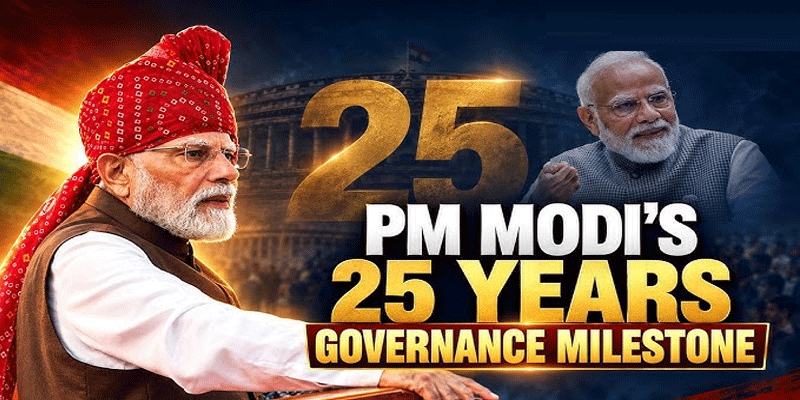
Prime Minister Narendra Modi created political history on June 10, 2026, by becoming India’s longest-serving continuously elected Prime Minister. With an uninterrupted tenure of 4,399 days since assuming office on May 26, 2014, Modi surpassed the record held by Jawaharlal Nehru, who served 4,398 days in office. The milestone marks a defining moment in India’s democratic journey and reflects Modi’s sustained electoral dominance over more than a decade of governance.
A Historic Political Milestone
Unlike Nehru’s tenure, which included different electoral phases in the formative years of independent India, Modi’s record represents an unbroken and continuously elected leadership mandate. His rise from leading the Bharatiya Janata Party’s sweeping 2014 victory to securing a third consecutive term in 2024 underscores a rare level of political continuity in Indian democracy.
The National Democratic Alliance (NDA), under Modi’s leadership, returned to power in the 2024 Lok Sabha elections with 292 seats, enabling him to take oath for a third consecutive term on June 9, 2024. The achievement places Modi among the world’s longest-serving democratically elected leaders and highlights the BJP’s transformation into India’s dominant national political force.
Global Leaders Congratulate Modi
The milestone drew congratulatory messages from leaders across the world, reflecting Modi’s growing international stature. Giorgia Meloni publicly congratulated Modi on social media, describing the occasion as historic and emphasizing the strengthening of India-Italy ties through the recently launched “Special Strategic Partnership.”
Her message also referred to Modi’s recent visit to Rome, where both nations expanded cooperation in trade, defence, clean energy and technology. The India-Italy engagement has become increasingly significant amid shifting geopolitical and economic alignments.
Apart from Meloni, leaders and dignitaries from the United States, Malaysia, Sri Lanka, Papua New Guinea and Trinidad and Tobago also acknowledged the achievement. Public figures, including singer and India supporter Mary Millben, praised Modi’s leadership and India’s growing global influence under his tenure.
Transformative Welfare and Development Initiatives
Under the Jal Jeevan Mission, more than 15 crore rural households received tap water connections, while nearly 12 crore toilets were constructed under the Swachh Bharat Mission, significantly improving sanitation coverage across rural India.
The Saubhagya scheme helped electrify nearly 2.86 crore households, expanding electricity access to remote regions. Housing initiatives under PM Awas Yojana resulted in the completion of almost four crore homes for economically weaker sections.
In healthcare, Ayushman Bharat emerged as one of the world’s largest public health insurance programmes, covering nearly 55 crore people. The government also expanded welfare through schemes such as PM Ujjwala Yojana, which distributed over 10 crore LPG connections to women from low-income households.
Economic Growth and Social Transformation
Modi’s tenure also witnessed a strong push toward entrepreneurship and manufacturing. The “Make in India” initiative encouraged domestic production and foreign investment, while India’s startup ecosystem expanded rapidly, producing more than 100 unicorns.
The government promoted women’s empowerment through increased maternity leave benefits, financial inclusion schemes and stronger local governance participation. Programmes like PM SVANidhi for street vendors and PM Vishwakarma for traditional artisans aimed to support small entrepreneurs and informal workers.
Infrastructure expansion under the PM GatiShakti National Master Plan further improved logistics connectivity, highways, freight corridors and digital integration.
A Defining Era in Indian Politics
Narendra Modi’s record as India’s longest-serving continuously elected Prime Minister is more than a personal political milestone; it represents a transformative phase in India’s governance model, welfare delivery and global engagement.
Supporters view his tenure as a period of decisive leadership, infrastructure growth and enhanced international standing, while critics continue to debate issues surrounding economic inequality, institutional balance and social polarization. Yet, few dispute the scale of political continuity and administrative reach achieved during his leadership.
As India navigates an increasingly complex global and domestic landscape, Modi’s historic tenure will remain central to discussions about the country’s democratic evolution, development priorities and emerging geopolitical role in the 21st century.
(With agency inputs)