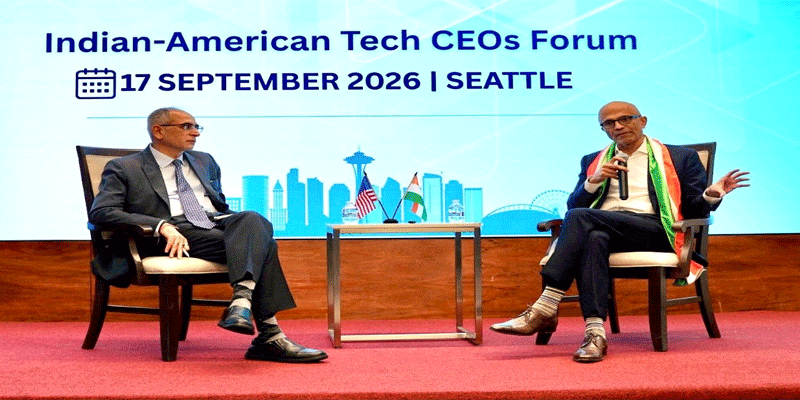
Microsoft Chairman and CEO Satya Nadella has praised the Seattle technology community’s growing relationship with India, describing the evolving partnership as an important bridge between innovation, talent and the global diffusion of artificial intelligence. His remarks came at the “Ideas4India: Indian American Tech CEOs Forum | Unlocking the Tech Dividend” in Seattle on September 17, where more than 40 Indian-origin technology leaders discussed ways to deepen India-US cooperation in emerging technologies.
Seattle’s Tech Rise and India Connection
Over roughly three decades, Greater Seattle has developed into a major technology ecosystem anchored by companies such as Microsoft and Amazon, alongside businesses working in AI, cloud computing, aerospace, semiconductors and enterprise software. Indian-origin professionals have become an important part of this ecosystem, occupying senior positions while also contributing as engineers, founders and technology executives.
The relationship is increasingly two-way. Greater Seattle-based companies have announced more than $50 billion in investments in India this decade, while maintaining substantial engineering, research and business operations there.
Nadella’s Key Message on AI And India
Nadella said he was proud to have watched Seattle’s technology community develop over approximately 35 years and welcomed its strengthening relationship with India. He also highlighted several broader themes:
· AI as a general-purpose technology: Nadella argued that the economic benefits of AI will depend on its broad diffusion across countries, communities and sectors rather than remaining concentrated in a limited number of markets.
· India’s human capital: He highlighted India’s engineering and technology talent and its growing importance to the global AI ecosystem.
· A rapidly expanding developer base: Nadella has pointed to India’s potential to become home to the world’s largest developer community by 2030.
· Infrastructure and skills: He stressed the importance of building computing infrastructure, specialised skills and sovereign capabilities to support an AI-first economy.
· Global cooperation: His remarks also addressed the need for international norms that allow countries to retain sovereignty over knowledge and intelligence while avoiding excessive fragmentation of technology.
Microsoft’s Expanding India Commitment
The discussion comes alongside Microsoft's announced $17.5 billion investment in India between 2026 and 2029, its largest investment in Asia. The programme covers cloud and AI infrastructure, operations and workforce development, including an expanded skilling effort targeting 20 million people by 2030.
This makes the Seattle-India relationship increasingly relevant not merely to software services, but to AI infrastructure, research, skills and technology deployment at population scale.
From Diaspora Links to Strategic Partnership
India's Ambassador to the US, Vinay Kwatra, told the forum that the India-US technology partnership should remain focused on practical development outcomes. He emphasised inclusivity, openness, sovereignty, democratised access, safety and trust as principles for India's AI mission.
The forum is also expected to contribute to the India-US TRUST Initiative, which seeks deeper cooperation across AI, quantum technologies, semiconductors, space, telecommunications and biotechnology.
Seattle-India Partnership Enters a New Technology Era
The significance of Nadella’s remarks lies in the evolution of the relationship from a traditional talent connection into a broader technology partnership. Seattle supplies global innovation networks, while India offers a vast engineering base, expanding digital infrastructure and an enormous potential market for AI.
As these capabilities become increasingly interconnected, the Seattle-India corridor could become an important channel for co-development, investment, talent exchange and responsible AI adoption—linking two technology ecosystems at a time when artificial intelligence is reshaping the global economy.
(With agency inputs)