Homegrown ‘Eye in the Sky’ Achieves Final Operational Milestone
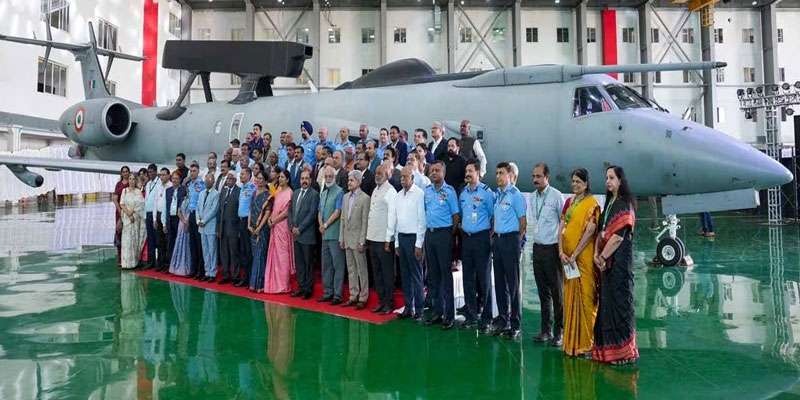
The indigenous Netra Airborne Early Warning and Control (AEW&C) system, which served as a crucial force multiplier for the Indian Air Force (IAF) during the 2019 Balakot airstrikes and Operation Sindoor, received its Final Operational Clearance (FOC) on Thursday. The certification marks a significant milestone in India's defence modernisation programme, confirming that the homegrown airborne surveillance platform is now fully operational for frontline military service. Developed by the Defence Research and Development Organisation (DRDO), Netra significantly enhances India's ability to detect, track and respond to aerial threats while strengthening the country's push towards defence self-reliance.
India's First Indigenous Airborne Surveillance Platform
Netra is India's first indigenously developed Airborne Early Warning and Control system, designed by the Bengaluru-based Centre for Airborne Systems (CABS), a DRDO laboratory. Mounted on the Embraer EMB-145I aircraft, the platform integrates an advanced Active Electronically Scanned Array (AESA) radar, Identification Friend or Foe (IFF) systems, mission computers, secure communication networks, electronic support measures and communication support systems into a single airborne command-and-control platform.
Unlike conventional ground-based radars, AEW&C aircraft operate at high altitudes, enabling them to detect, identify and track aircraft, missiles and certain maritime threats over much longer distances. They also function as airborne command centres, providing real-time intelligence, coordinating fighter aircraft, directing interceptions and significantly improving battlefield awareness during military operations.
The project has been under development for over a decade. Netra received its Initial Operational Clearance (IOC) in 2017, following extensive testing and integration with the Indian Air Force. The Final Operational Clearance now certifies that the platform has successfully completed all operational, technical and safety evaluations required for full deployment.
Operational Success Reinforced by Real Combat Experience
Netra's operational credibility had already been established during critical national security missions. Defence officials have previously acknowledged its important surveillance and battle-management role during the Balakot airstrikes in 2019, when the Indian Air Force carried out precision strikes against terrorist infrastructure across the Line of Control. The system was also effectively deployed during Operation Sindoor, providing enhanced situational awareness and supporting air operations through real-time monitoring and coordination.
The Final Operational Clearance therefore validates not merely laboratory performance but a system that has already demonstrated its effectiveness in actual operational environments.
The milestone also carries emotional significance. Scientists and Air Force personnel dedicated the achievement to colleagues who lost their lives in the 1999 aircraft accident during the early stages of India's airborne surveillance programme, symbolising decades of perseverance and technological advancement.
Strategic Importance for India's Defence Preparedness
The clearance places India among a select group of nations capable of designing, developing and operating indigenous AEW&C systems. Such platforms are technologically sophisticated, strategically sensitive and essential for modern network-centric warfare.
Perhaps more importantly, indigenous capability reduces dependence on foreign suppliers, allows greater flexibility in future upgrades and enables seamless integration with Indian-developed fighter aircraft, missile systems and defence communication networks. As regional security challenges continue to evolve, airborne surveillance assets like Netra will play an increasingly central role in strengthening India's integrated air defence architecture.
A Foundation for Future Air Power
The Final Operational Clearance of Netra represents far more than the completion of a defence project—it marks the maturation of India's indigenous airborne surveillance capabilities. As the Indian Air Force continues to modernise its operational network, the focus will now shift towards expanding the AEW&C fleet, integrating it with advanced defence systems and enhancing joint-force operations across the Army, Navy and Air Force. Netra's success not only strengthens India's immediate security preparedness but also lays the foundation for the next generation of indigenous airborne command-and-control platforms that will shape the country's future air power.
(With agency inputs)