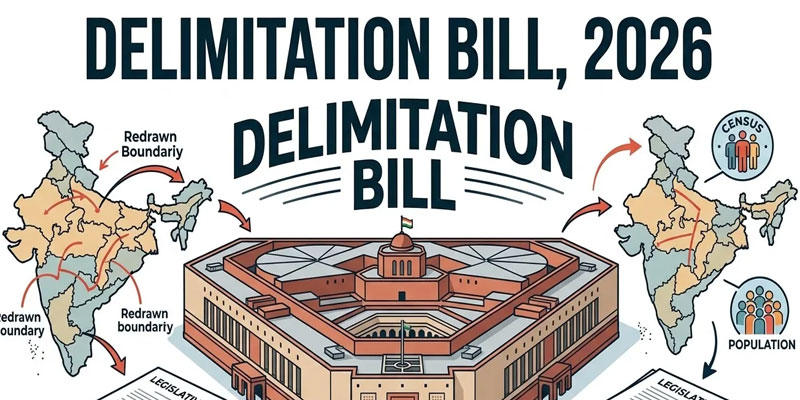
The government is preparing to introduce the Constitution (131st Amendment) Bill, 2026, alongside the Delimitation Bill, 2026—two measures that could fundamentally reshape India’s parliamentary democracy. At the heart of the proposal is a dramatic expansion of the Lok Sabha from 543 seats to a maximum of 850, with 815 seats allocated to states and 35 to Union Territories. This move, combined with the long-awaited operationalization of women’s reservation, signals a decisive shift toward aligning representation with contemporary demographic realities.
The Core Proposal: Expansion and Representation Reform
The Constitution (131st Amendment) Bill, 2026, seeks to implement the 33% reservation for women in the Lok Sabha and state assemblies under the Nari Shakti Vandan Adhiniyam, 2023. Crucially, it enables delimitation based on the 2011 Census rather than the frozen 1971 data, unlocking a long-stalled process of redrawing electoral boundaries.
Paired with it, the Delimitation Bill, 2026, proposes increasing parliamentary seats to better reflect population growth, urbanization, and internal migration. One-third of these expanded seats will be reserved for women, potentially transforming gender representation in Indian politics.
Who Gains How Many Seats? A Likely Redistribution
If the total strength rises to 850, the additional 307 seats would largely follow population trends captured in the 2011 Census. Northern and central states—where population growth has been higher—are expected to gain the most.
· Uttar Pradesh could see its seats rise from 80 to around 120–125, consolidating its position as the largest political battleground.
· Bihar may increase from 40 to approximately 65–70 seats.
· Madhya Pradesh and Rajasthan could gain 10–15 additional seats each, taking them closer to the 40–45 range.
· Maharashtra, already a large state, may expand from 48 to about 65–70 seats.
In contrast, southern states—where population growth has stabilized—may see smaller increases:
· Tamil Nadu might move from 39 to around 50 seats.
· Karnataka could rise from 28 to about 40.
· Kerala, with slower growth, may only see a marginal rise from 20 to 25.
Union Territories collectively would account for 35 seats, up from the current 20, reflecting urban expansion in regions like Delhi and Jammu & Kashmir.
Government Strategy: Building Consensus
The government has framed these reforms as both a democratic correction and a milestone in women’s empowerment. With outreach to opposition leaders and assurances of proportionality, it aims to prevent regional imbalances from derailing the process. The target is clear: complete delimitation and implement women’s reservation before the 2029 general elections.
Opposition Concerns: Federal Balance at Stake
Opposition parties broadly support women’s reservation but object to linking it with delimitation. Their central concern is that expanding seats based on population could disproportionately benefit northern states, altering the federal balance. Southern states argue that their success in population control should not translate into reduced political influence.
There is also resistance to using the 2011 Census rather than waiting for updated data from the next Census, with critics warning of premature restructuring.
A Defining Moment for Indian Democracy
These twin bills represent one of the most consequential electoral reforms in decades. On one hand, they promise fairer representation and a historic boost for women in politics. On the other, they reopen sensitive questions about regional equity and federal balance. The outcome will depend on whether political consensus can reconcile demographic justice with cooperative federalism. If achieved, this reform could redefine the scale, inclusivity, and legitimacy of India’s लोकतांत्रिक framework for generations to come.
(With agency inputs)