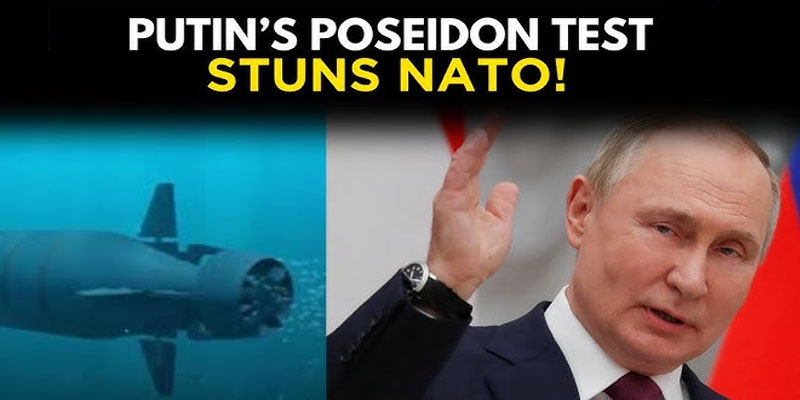
Moscow’s Deep-Sea Power Play
Russia has taken another dramatic step in modernizing its nuclear arsenal. On October 29, 2025, President Vladimir Putin announced the successful test of the Poseidon—a nuclear-powered, nuclear-armed underwater drone capable of traversing oceans autonomously. The announcement came just days after the trial of the Burevestnik nuclear-powered cruise missile, signaling Moscow’s determination to project strength amid its ongoing confrontation with the United States and NATO over Ukraine.
The Poseidon test is not just a technological breakthrough—it is a geopolitical message. In an era where the boundaries of deterrence are being redrawn, Russia’s underwater “superweapon” challenges existing security assumptions and raises fresh fears of a new nuclear arms race beneath the waves.
Unveiling Poseidon: Capabilities and Purpose
The Poseidon, known to NATO as “Kanyon” and previously codenamed Status-6, is unlike any weapon the world has seen. It’s an autonomous underwater vehicle designed to be launched from submarines and powered by a compact nuclear reactor, allowing it to travel virtually unlimited distances at high speeds and extreme depths.
According to Putin, Poseidon “outperforms all existing platforms in speed and depth,” making it impossible to intercept with current naval defenses. Russian state media reports the drone can reach speeds of up to 100 knots and operate thousands of meters below the surface—levels that would evade most detection systems.
But it’s the payload that makes Poseidon uniquely terrifying. It is reportedly designed to carry a massive nuclear warhead, potentially even larger than Russia’s Sarmat ICBM, and detonate near coastal cities. Such an explosion could unleash a radioactive tsunami, devastating entire shorelines and rendering them uninhabitable for decades.
The recent trial marked a first: the drone operated for a sustained duration on nuclear power, confirming progress toward full operational readiness.
Strategic Messaging: Deterrence by Fear
Analysts view the Poseidon test as part of Russia’s broader campaign to reassert nuclear dominance and deter Western intervention. By unveiling new “doomsday” technologies, Moscow aims to reinforce the image of a power that cannot be cornered militarily or technologically.
The psychological impact is deliberate. A weapon capable of silently cruising the ocean floor for months and delivering catastrophic strikes introduces a new form of uncertainty into global security calculations. Even if never used, Poseidon’s mere existence reshapes the deterrence landscape by emphasizing unpredictability and the threat of mutual devastation.
The test’s timing—alongside sanctions from Washington and stalled peace talks over Ukraine—signals Moscow’s intent to demonstrate resilience and self-reliance despite international isolation.
Global Reactions: Alarm and Ambiguity
Western governments and defense experts have responded with alarm and skepticism. While independent verification of Poseidon’s performance is still limited, US and NATO intelligence agencies acknowledge steady progress in Russia’s undersea capabilities.
Security analysts warn that Poseidon’s development could further destabilize nuclear deterrence frameworks, especially as existing arms control treaties like New START face expiration and no replacement agreements are in sight. The idea of autonomous nuclear systems operating without immediate human control has also raised ethical and safety concerns among non-proliferation advocates.
China has refrained from official comment but is believed to be closely studying Russia’s progress. Meanwhile, European states have renewed calls for reviving nuclear dialogue and transparency, warning that an uncontrolled arms race in autonomous nuclear weapons could upend decades of deterrence stability.
The Road Ahead: Rising Risks Beneath the Surface
Poseidon is one of six “next-generation” nuclear weapons unveiled by Putin in 2018, designed to counter what Russia perceives as Western strategic encirclement. With both the Poseidon and Burevestnik now undergoing operational trials, Russia appears committed to fielding weapons that bypass missile defense systems and expand the concept of deterrence beyond land, sea, and air—into the abyss of the ocean.
However, the long-term implications are troubling. The deployment of such systems could trigger reciprocal programs in other powers, especially the US and China, and complicate arms control negotiations that are already on life support. The blurred line between defense signaling and escalation risk grows ever thinner.
A Deepening Shadow Over Global Security
The Poseidon test marks a turning point in the evolution of nuclear strategy—a fusion of science, symbolism, and psychological warfare. For Russia, it’s proof of technological prowess and endurance under pressure; for the world, it’s a stark warning that the nuclear threat is no longer confined to missiles in silos or bombers in the sky.
As great powers descend into renewed rivalry, Poseidon’s silent patrols beneath the ocean’s surface may come to symbolize not deterrence, but the fragility of peace itself. Preventing a new underwater arms race will demand more than fear—it will require diplomacy, restraint, and a renewed global commitment to keeping humanity’s deadliest technologies in check.
(With agency inputs)