A New Chapter in Urban Mobility Begins
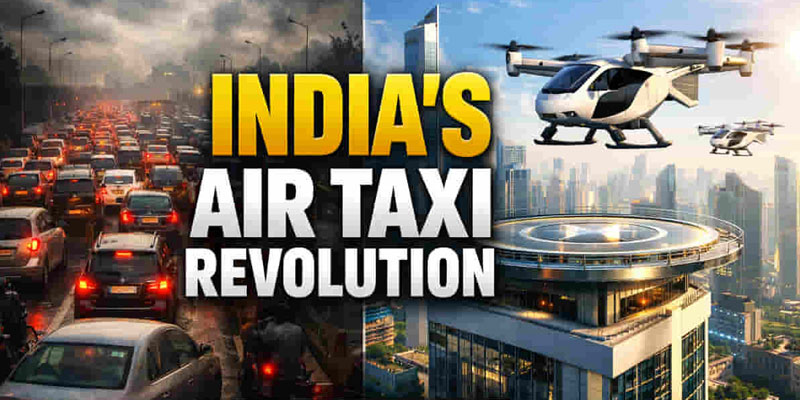
Air taxis may soon move from concept to concrete reality for Delhi-NCR commuters. With road congestion worsening and travel times stretching unpredictably, policymakers and industry stakeholders are exploring aerial mobility as a faster alternative. The idea: a network of electric air taxis connecting key business districts, airports, and suburban hubs. If implemented, a journey that currently takes an hour by road could be completed in minutes, signaling a major shift in how India’s largest urban cluster moves.
Rethinking the Commute
Delhi-NCR’s transport infrastructure faces mounting pressure from rapid population growth and rising vehicle ownership. Average road speeds during peak hours remain sluggish, and even with metro expansion, last-mile connectivity continues to challenge commuters. Against this backdrop, industry reports and aviation partnerships suggest that electric vertical take-off and landing aircraft—commonly known as eVTOLs—could offer a practical solution. The proposed air taxi network is being positioned not as a luxury novelty but as a supplementary mobility layer designed to reduce congestion and improve travel efficiency across the region.
Detailed Analysis: Promise and Practicalities
The concept centers on compact electric aircraft capable of vertical take-off from designated “vertiports” built on rooftops, parking structures, or open urban plots. These aircraft are designed for short-distance travel within cities, cruising at speeds that significantly reduce journey times between major hubs. For instance, routes connecting the international airport with corporate districts or satellite cities could shrink from an hour or more by road to under fifteen minutes by air.
From an economic standpoint, early projections indicate that initial fares may resemble premium ride-hailing services. However, as fleets expand and operations scale up, prices are expected to decline, making the service accessible to a wider commuter base. Several aviation and mobility firms have already expressed interest in trial operations, partnering with global eVTOL manufacturers. Industry timelines suggest pilot tests could begin later this decade, with commercial launches following if regulatory approvals and infrastructure readiness align.
Environmentally, electric air taxis offer notable advantages. They generate far fewer emissions than conventional cars and helicopters, aligning with Delhi’s broader efforts to tackle pollution. Infrastructure requirements are also comparatively modest. Vertiports occupy limited space and can often be integrated into existing buildings, reducing the need for large-scale land acquisition. This adaptability could allow the network to grow incrementally without massive construction projects.
How It Will Work: The Operational Blueprint
Passengers would book rides through mobile applications, similar to current ride-hailing platforms. Upon arrival at a vertiport, they would undergo brief security and boarding procedures before boarding compact electric aircraft. Flights would follow predefined aerial corridors managed by advanced air-traffic systems designed to coordinate drones, helicopters, and air taxis safely. Artificial intelligence-assisted navigation and real-time monitoring would help maintain efficient spacing and minimize risks. Initially, services may focus on high-demand routes, gradually expanding as infrastructure and public confidence grow.
Opportunity with Caveats
While the vision of airborne commuting is compelling, challenges remain. Regulatory approvals, airspace integration, and public acceptance will determine how quickly the concept moves from trials to everyday use. High upfront costs and the need for coordinated public-private investment also pose hurdles. Yet, if successfully implemented, air taxis could reshape urban mobility in Delhi-NCR—saving time, reducing road congestion, and setting a precedent for other Indian megacities. The region’s transport future may not only run on rails and roads but also take to the skies.
(With agency inputs)