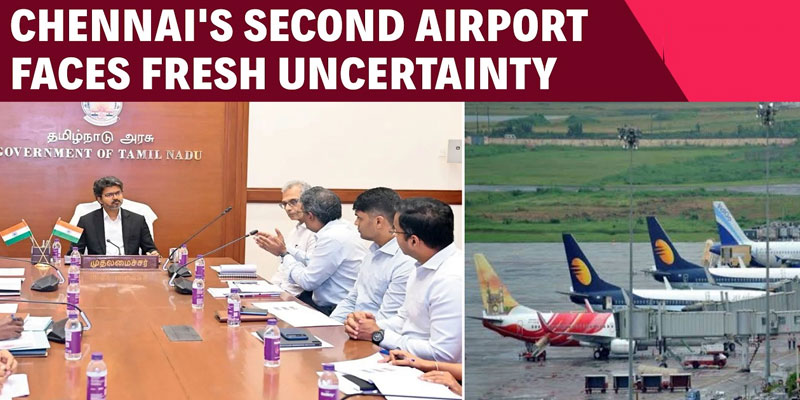
Tamil Nadu has abandoned the proposed ₹20,000-crore greenfield airport at Parandur, but not its ambition to build a second airport for Chennai. Chief Minister C. Joseph Vijay announced on August 24 that the government will search for alternative locations with significantly lower impact on agricultural land and residential settlements. In the meantime, Chennai’s existing Meenambakkam airport will be expanded to address rising demand.
Why Parandur Became Controversial
The Parandur project in Kancheepuram district was conceived as Chennai’s second aviation hub because the existing airport faces congestion and limited long-term expansion possibilities. Yet the proposal encountered sustained opposition from farmers, residents and environmental groups concerned about fertile farmland, displacement, water bodies and ecological disruption.
The government’s decision acknowledges that Chennai still urgently needs greater passenger and cargo capacity, but that infrastructure expansion cannot ignore its social and environmental costs.
An Industrial State Needs More Aviation Capacity
The decision carries major economic implications because Tamil Nadu is one of India’s strongest manufacturing centres. A federal government statement last year said the state accounted for roughly 15% of India’s factories and manufacturing employment, the highest among states.
Chennai’s industrial ecosystem—often described as “India’s Detroit”—includes major automobile manufacturers and extensive component networks. The state has also become an important electronics-manufacturing hub, with companies including Foxconn and Tata Electronics operating there. Efficient aviation infrastructure is therefore not simply about passengers. It supports executives, high-value cargo, exporters, investors and increasingly sophisticated manufacturing supply chains.
Expansion Before a New Airport
The government’s immediate solution is to expand the existing airport in partnership with the Airports Authority of India. Chennai airport currently handles around 30 million passengers annually. Its capacity is expected to reach 35 million following completion of Terminal 3.
A proposed Terminal 5, along with an approach road and flyover, could add another 20 million passengers annually, taking overall capacity towards 55 million passengers.
This provides a practical bridge while authorities identify a new site. Increasing terminal capacity and improving road connectivity can ease immediate congestion and protect Chennai’s connectivity with domestic and international markets.
However, expansion cannot entirely replace the strategic rationale for a second airport. A greenfield facility could eventually offer parallel runways, dedicated cargo infrastructure, maintenance facilities and integrated logistics parks—features difficult to develop within a constrained urban airport.
The Investment Imperative
The airport rethink comes as Tamil Nadu aggressively courts investment. In August, the state signed 97 investment agreements worth ₹674.52 billion, potentially generating more than 100,000 jobs. The commitments included projects involving overseas investors, Saint-Gobain and Super Micro Computer, alongside major domestic companies.
This investment pipeline will increase pressure for reliable transport infrastructure.
Growth Must Now Find Common Ground
Tamil Nadu’s decision to shelve Parandur demonstrates that infrastructure ambition cannot be separated from land, livelihoods and environmental realities. The next challenge is finding a site that can meet Chennai’s long-term aviation needs without recreating the same conflict.
A transparent selection process, rigorous environmental assessment, meaningful community consultation and credible rehabilitation will be essential. Tamil Nadu has postponed the airport, not the ambition; its real test now is delivering capacity without sacrificing public trust.
(With agency inputs)