Former Delhi minister and Aam Aadmi Party (AAP) leader Satyendar Jain was arrested on August 18, 2026, by the Delhi government’s Anti-Corruption Branch (ACB) over alleged manipulation of a tender process at the Delhi Jal Board (DJB). The case, registered under the Prevention of Corruption Act and relevant IPC sections, involves six accused, including Jain, former DJB CEO Udit Prakash Rai, and four private individuals linked to the favoured firm Euroteck Environment Pvt Ltd.
The Alleged Scam
The FIR, filed on May 11, 2024, pertains to large-scale irregularities in the tendering process for augmentation and upgradation of sewage treatment plants (STPs) under the DJB. ACB investigations allege that tender conditions were deliberately tailored with restrictive technical specifications to favour Euroteck Environment, stifling fair competition. Key lapses include the omission of essential effluent parameters, bypassing of a mandatory pilot study, and sudden insertion of technical changes that allegedly granted unfair financial benefits to the private entity at the cost of the public exchequer. The probe further claims a bribe trail of ₹1.52 crore routed to then-CEO Udit Prakash Rai through banking channels from AN Enterprises, a proprietorship concern of Nagendra Yadav, with the funds allegedly used to purchase immovable property.
Jain’s Role and Past Legal Troubles
Jain, who served as Delhi’s water resources minister, is accused of being part of a criminal conspiracy that facilitated the manipulated tender process. This is not his first brush with the law: in May 2022, he was arrested in a money-laundering case linked to alleged shell companies and spent nearly 18 months in Tihar Jail before being granted bail in October 2023. His release and subsequent political activities had positioned him as a key strategist for AAP’s upcoming Punjab Assembly elections, due by February 2027.
Political Reaction: AAP’s “Vendetta” Claim
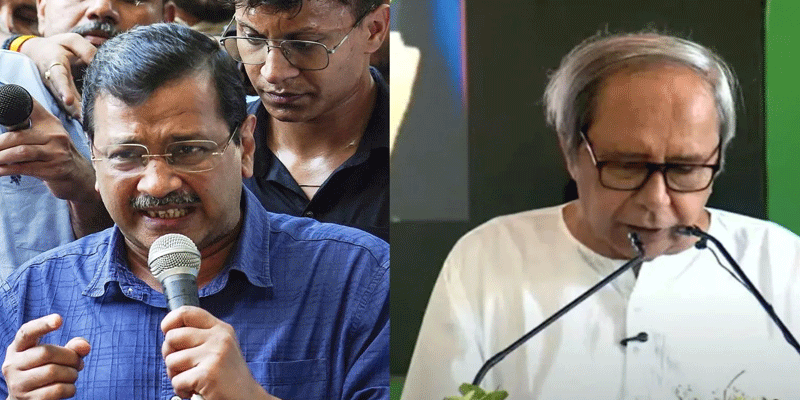
AAP leaders have dismissed the arrest as politically motivated, alleging it is part of a BJP-led vendetta ahead of the Punjab polls. Party spokesperson Priyanka Kakkar termed the DJB case “fake,” while national convener Arvind Kejriwal claimed Jain was arrested at the behest of the BJP to weaken AAP’s election strategy. Manish Sisodia, another senior AAP leader, emphasised that Jain was in jail during the tender approval process, questioning the timing and intent of the arrest.
Analytical Implications
The arrest underscores the intersection of governance, accountability, and political strategy in Delhi’s polarised environment. While the ACB’s evidence—electronic communications, financial trails, and procedural lapses—suggests a serious probe, AAP’s counter-narrative frames it as electoral engineering by the ruling dispensation. The case also highlights systemic vulnerabilities in public procurement, where technical specifications can be manipulated to favour specific bidders. As the legal process unfolds, the outcome will test both the credibility of Delhi’s anti-corruption mechanisms and AAP’s resilience ahead of a critical electoral cycle.
(With agency inputs)