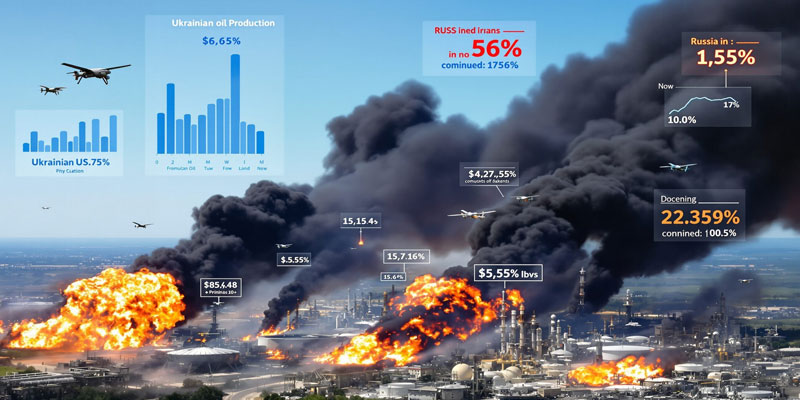
Overnight Strikes Signal Escalation in Economic Warfare
Ukrainian drones struck a pair of Volga riverside industrial cities, along with a key Baltic Sea port near St. Petersburg, in a coordinated overnight assault on April 17–18, 2026. Russian regional governors confirmed the attacks, describing fires and attempted strikes on critical infrastructure. While officials emphasized that damage was contained and casualties avoided, the scale and reach of the strikes point to a deepening phase of the conflict—one that increasingly targets economic assets rather than just battlefield positions.
Targets: Ports and Refineries Under Fire
The strikes focused on strategically vital energy hubs. In the northwest, the Baltic port of Vysotsk—operated by Lukoil and used to export refined petroleum products such as diesel and fuel oil—reported a fire that was later extinguished. Meanwhile, in the Samara region along the Volga River, industrial facilities in Syzran came under attack. These cities host major Rosneft refineries, each capable of processing roughly 220,000 barrels per day.
Though Russian authorities downplayed the impact, these sites have been repeatedly targeted since 2024, suggesting a sustained Ukrainian campaign aimed at degrading refining capacity and export logistics.
Why These Strikes Matter Strategically
The choice of targets reveals a deliberate strategy. Vysotsk plays a crucial role in Russia’s Baltic export network, especially after disruptions at other ports like Ust-Luga. Any interruption here adds pressure to Russia’s already strained oil export routes.
The Volga refineries, on the other hand, are central to domestic fuel supply and military logistics. Repeated hits on such facilities have reportedly reduced Russia’s refining capacity by a significant margin over time. By targeting these nodes, Ukraine is not just inflicting immediate damage but also gradually eroding Russia’s ability to sustain both its economy and military operations.
Evolution of Ukraine’s Drone Warfare
A defining feature of these attacks is the increasing sophistication of Ukraine’s drone capabilities. Long-range drones, capable of traveling up to 1,800 kilometers, are now reaching deep into Russian territory. These systems often overwhelm air defenses through coordinated “swarm” tactics, allowing some to penetrate and strike high-value targets.
This marks a shift from earlier phases of the war, where drones were primarily used near the frontlines. The current approach reflects a broader doctrine of economic attrition—weakening the adversary’s industrial base and financial resources over time.
Russia’s Response: Containment and Caution
Russian authorities responded by emphasizing defensive success. The Ministry of Defence claimed that over 90 drones were intercepted nationwide, while regional officials highlighted rapid firefighting efforts and minimal disruption. The messaging focused on control and resilience, avoiding immediate escalation in rhetoric.
However, past patterns suggest that retaliation may follow, often in the form of intensified strikes on Ukraine’s energy infrastructure. At the same time, Russia is reportedly strengthening air defenses around critical facilities and rerouting exports to mitigate risks.
A War Expanding Beyond the Battlefield
These latest drone strikes underscore a critical shift in the conflict’s dynamics. The war is no longer confined to territorial gains but is increasingly about economic endurance and strategic disruption. Ukraine’s ability to hit deep, high-value targets challenges Russia’s sense of security and puts sustained pressure on its energy-dependent economy. As both sides adapt, the conflict is evolving into a prolonged contest of resilience—where infrastructure, supply chains, and economic stability may prove just as decisive as military strength.
(With agency inputs)