Why Iran Has Emerged as the Bigger Winner
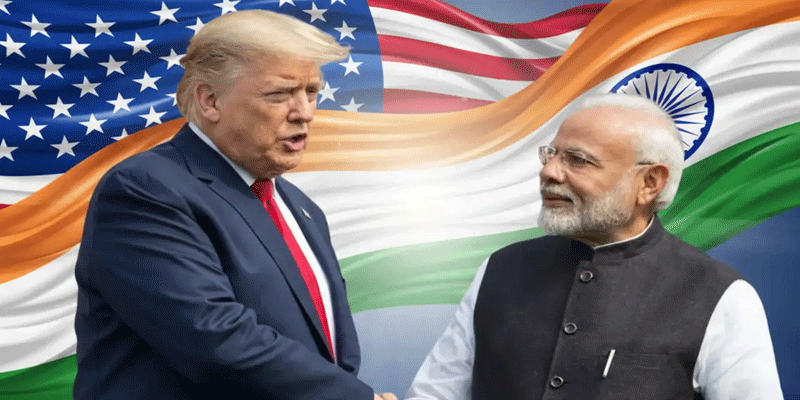
After months of military confrontation, economic pressure, and high-stakes diplomacy, the June 17, 2026 Memorandum of Understanding (MoU) signed by US President Donald Trump and Iran has been presented as a breakthrough capable of ending a conflict that threatened global economic stability. Washington has highlighted the reopening of the Strait of Hormuz as the agreement’s central achievement. Yet a closer reading of the 14-point pact suggests that Iran has emerged with significantly broader and more durable gains.
Trump himself acknowledged the gravity of the situation, arguing that the alternative to the agreement would have been a “worldwide depression” and that without the deal, the Strait of Hormuz would not have reopened. That statement alone reflects the leverage Tehran acquired during negotiations, enabling it to convert military and geopolitical pressure into economic and strategic concessions.
From Escalation to Negotiated Settlement
The agreement comes after a prolonged period of conflict that disrupted regional stability and threatened one of the world’s most critical energy corridors. The Strait of Hormuz, through which roughly one-fifth of global oil consumption passes, became the focal point of international concern as tensions escalated.
Faced with mounting economic risks and fears of prolonged disruption to global energy markets, both sides entered negotiations. The resulting MoU seeks to establish a framework for de-escalation while postponing some of the most contentious issues for future talks.
The Strait of Hormuz: A Temporary American Success
The most visible American gain is the restoration of commercial shipping through the Strait of Hormuz. Under the agreement, Iran will permit safe passage for commercial vessels free of charge for a period of 60 days.
However, the arrangement is temporary. After this period, Iran and its Gulf neighbours, including Oman, will determine a new maritime administration mechanism consistent with international law. This provision opens the possibility for future transit charges. Iranian officials have already indicated that fees could be introduced once the initial grace period expires.
As a result, what appears to be a major American victory may ultimately evolve into a long-term economic advantage for Iran, given the strategic importance of one of the world's busiest energy chokepoints.
Economic Relief: Tehran’s Biggest Achievement
The most substantial benefits of the agreement are economic. Iran secures immediate waivers for oil exports, a phased lifting of sanctions, and access to frozen financial assets once implementation begins.
Even more significant is the creation of a $300 billion private investment fund, with more than half of the capital reportedly already pledged. While officially structured as an investment vehicle rather than a reconstruction programme, the fund provides Tehran with unprecedented access to foreign capital at a time when its economy has been constrained by years of sanctions.
Together, these measures shift Iran from economic isolation toward economic recovery.
An End to Conflict on All Fronts
A defining feature of the MoU is its effort to reduce tensions across the wider region. The agreement establishes a ceasefire not only between the United States and Iran but also extends to the Israel-Hezbollah front in Lebanon.
For Tehran, this was a key negotiating objective. The arrangement potentially reduces pressure on Iran’s regional network of allies while lowering the risk of a broader regional war. By linking multiple theatres of conflict into a single de-escalation framework, the agreement aims to create a more comprehensive and sustainable peace architecture.
Nuclear Programme: Delayed Decisions
The nuclear issue, long at the centre of US-Iran tensions, remains largely unresolved. The MoU prohibits Iran from developing nuclear weapons but leaves detailed arrangements for future negotiations.
Existing enriched material will be managed through supervised down-blending under International Atomic Energy Agency oversight. However, the broader framework preserves the current status quo, allowing Tehran to retain flexibility until a final settlement is negotiated.
A Deal That Favours Tehran
While the United States can claim success in reopening the Strait of Hormuz and reducing the immediate risk of global economic disruption, Iran appears to have secured the more consequential gains. Economic sanctions relief, oil export waivers, access to massive investment capital, recovery of frozen funds, and a wider regional ceasefire collectively strengthen Tehran’s position. The agreement transforms a period of confrontation into an opportunity for economic and strategic consolidation, making Iran the clear long-term beneficiary of a deal designed to prevent a much larger crisis.
(With agency inputs)