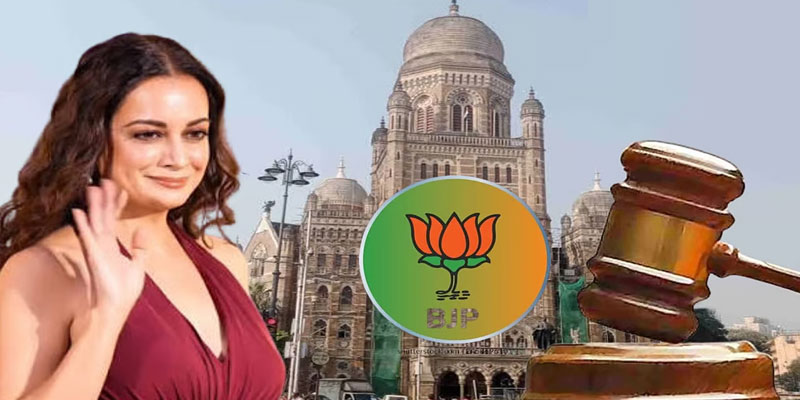
In an awareness video for the Brihanmumbai Municipal Corporation (BMC), actor Dia Mirza appealed to citizens, citing a Bombay High Court order, not to burst firecrackers on public roads. What was intended as an environmental and public-health awareness initiative soon became a political controversy after the civic body removed the video following objections from BJP leaders. Now, the Bombay High Court has strongly criticised the BMC and ordered the restoration of the video, emphasising that environmental protection must not be given a religious or political colour.
How Did the Dia Mirza Video Controversy Begin?
Mirza had recorded the video at the BMC's request as part of its eco-friendly, firecracker-free Diwali awareness campaign. Her message specifically urged citizens not to burst firecrackers on public roads, lanes and footpaths, referring to restrictions imposed by the High Court.
However, the video was subsequently removed from the civic body's social-media platforms following objections from Mumbai BJP chief Ameet Satam and Mayor Ritu Tawde.
The removal triggered questions about whether a public-health campaign was being unnecessarily drawn into political and religious debates.
What Did the Bombay High Court Say?
On November 3, a Division Bench comprising Justice Girish Kulkarni and Justice Dr Neela Gokhale expressed deep pain and displeasure over the controversy while hearing its suo motu proceedings concerning festive noise and air pollution in Mumbai.
The court directed the BMC to re-upload Mirza's video to restore public confidence.
Its central observations were significant:
· India is a secular country, and environmental protection cannot be communalised.
· Air pollution and public health affect citizens irrespective of religion or caste.
· Judicial directions issued in the public interest must be implemented without political interference.
· An environmental awareness message should not be interpreted through a religious or partisan lens.
The court effectively reminded civic authorities that public-health communication must remain neutral and responsible.
What Is the Legal Background?
The controversy originates from the High Court's September 22 order prohibiting firecrackers on public streets and roads and restricting laser-light use during festivities.
Importantly, these restrictions apply throughout the year, covering all festivals, including Diwali.
Mirza's message was therefore not an independent demand for a blanket prohibition on Diwali celebrations or private firecracker use. It specifically encouraged compliance with the judicial restriction on bursting firecrackers in public spaces.
Who Gains and Who Faces Criticism?
The immediate beneficiary is environmental governance, as the court has reinforced the importance of communicating pollution-control measures without political considerations.
Mirza's campaign has also received judicial validation. Conversely, the BMC's institutional credibility has suffered because removing the video raised questions about its independence in implementing court directions.
When Environmental Responsibility Must Rise Above Politics
The controversy carries a larger constitutional message: environmental protection and public health cannot become casualties of political disagreements. Celebrating festivals and respecting environmental responsibilities need not be conflicting objectives. The Bombay High Court's intervention reinforces that civic authorities must uphold judicial directions impartially, irrespective of political pressure. Ultimately, the issue is not about restricting religious celebrations but ensuring that public spaces remain safe, healthy and accessible to everyone.
(With agency inputs)