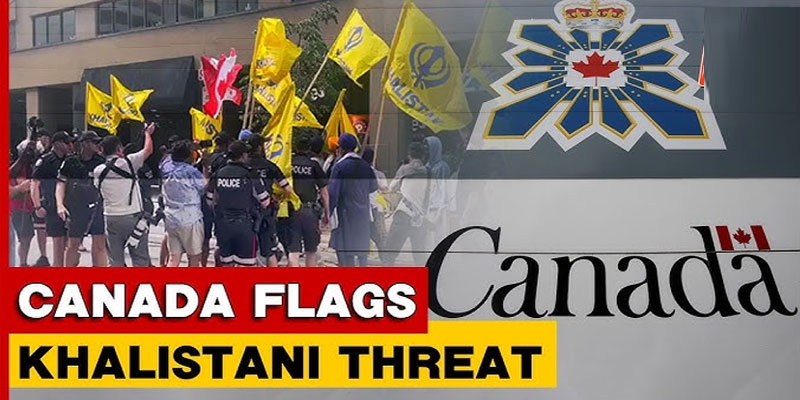
In a significant recalibration of its internal security stance, Canada has formally declared Khalistani extremists a “national security threat” in its latest intelligence assessment. The move, outlined in the 2025 report of the Canadian Security Intelligence Service (CSIS), marks a notable shift in Ottawa’s approach, placing these groups at the centre of its evolving security priorities.
A New Security Classification with Strategic Implications
The CSIS report identifies “Canada-based Khalistani extremists” (CBKE) as an active threat, not only within Canada but also to its international relationships—particularly with India. This classification underscores concerns that such groups may engage in activities that extend beyond political advocacy into extremist or potentially violent domains.
The timing is also significant. The designation comes in the aftermath of the 40th anniversary of the Air India Flight 182 bombing, one of the deadliest aviation terror attacks in history, which has long been associated with Khalistani-linked extremism. The anniversary has revived attention on unresolved security gaps and historical accountability, prompting Canadian authorities to reassess threats tied to such movements.
Understanding the Khalistan Movement and Extremism Debate
Khalistani groups advocate for a separate Sikh-majority state—Khalistan—carved out of India’s Punjab region. While many supporters engage in peaceful political activism, certain factions have been linked to violent campaigns, including targeted killings and insurgency during the 1980s and 1990s.
India has consistently labelled several of these organisations as terrorist entities, citing their role in destabilising the region. By adopting the “national security threat” label, Canada appears to be aligning more closely with India’s long-standing concerns, though it continues to draw a distinction between violent extremism and legitimate political expression within the Sikh diaspora.
This nuanced position reflects Canada’s broader challenge: balancing civil liberties with national security in a multicultural society.
Diplomatic Fallout and Gradual Recalibration
The issue of Khalistani extremism has been a major point of contention in India-Canada relations. Ties hit a historic low in 2023 when then Prime Minister Justin Trudeau alleged potential involvement of Indian agents in the killing of Hardeep Singh Nijjar, a Sikh separatist leader, on Canadian soil. India strongly rejected the claim, calling it politically motivated.
The fallout led to diplomatic expulsions and a freeze in bilateral engagement, straining cooperation across trade and strategic sectors. However, under Prime Minister Mark Carney, both nations have shown signs of cautious re-engagement.
The CSIS report can be interpreted as part of this recalibration. By explicitly identifying extremist elements as a threat, Canada is signaling a willingness to address India’s core security concerns without undermining its own democratic principles.
Balancing Domestic Politics and Global Partnerships
For Canada, the move carries both domestic and international implications. Internally, it reinforces the government’s commitment to countering extremism while maintaining protections for free speech and political dissent. Externally, it serves as a diplomatic gesture toward India, potentially easing tensions and reopening channels for cooperation.
However, the distinction between extremist activity and diaspora advocacy remains delicate. Any perceived overreach could trigger backlash within Canada’s Sikh community, making implementation as critical as policy declaration.
A Strategic Shift with Long-Term Consequences
Canada’s decision to label Khalistani extremists as a national security threat represents more than a semantic change—it signals a strategic pivot in how Ottawa views and manages this complex issue. While it does not resolve all outstanding disputes with India, it creates space for dialogue and cooperation on shared security concerns.
Going forward, the effectiveness of this shift will depend on careful execution—ensuring that counter-extremism measures are precise, proportionate, and respectful of democratic values. If managed well, it could mark the beginning of a more balanced and pragmatic phase in India-Canada relations, while strengthening Canada’s own national security framework.
(With agency inputs)