Government opens talks as protests continue at Jantar Mantar
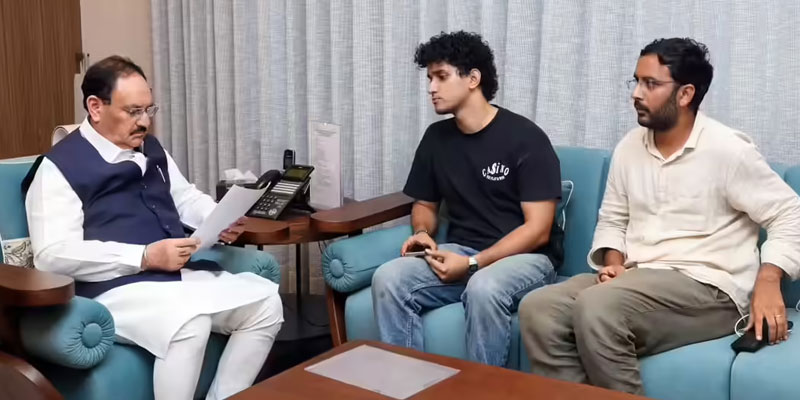
In a significant development amid the ongoing agitation over alleged examination irregularities, leaders of the Cockroach Janta Party (CJP) met Union Health Minister and BJP president J.P. Nadda, submitting a formal letter outlining the movement's demands. The government is expected to issue a statement on the meeting, while sources indicated that authorities have decided not to forcibly evict protesters from Jantar Mantar. The twin developments suggest an attempt to reduce tensions through engagement, even as security restrictions around Parliament remain firmly in place.
From NEET protests to a nationwide movement
The CJP emerged as a youth-led platform following widespread outrage over alleged irregularities in NEET-UG and other competitive examinations. Its campaign argues that repeated paper leaks, administrative failures and recruitment controversies have eroded faith in India's merit-based education system while contributing to severe psychological distress among students.
The movement's central demand remains the resignation of Union Education Minister Dharmendra Pradhan, whom it holds politically accountable for the alleged lapses. Over time, however, its agenda has expanded into a broader five-point charter calling for comprehensive exam reforms, a white paper on unemployment, greater government transparency, an audit of PM CARES and an apology over remarks referring to protesters as "cockroaches." Demonstrations have spread beyond Delhi to Bengaluru, Ahmedabad, Surat, Nagpur and several other cities, reflecting growing national resonance.
Security strategy around Parliament
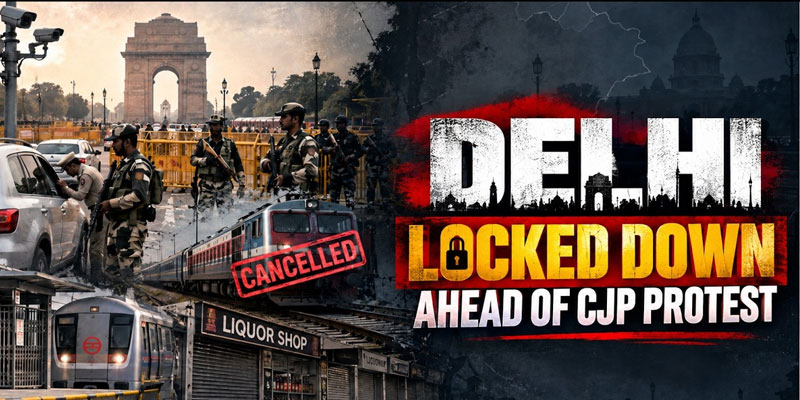
Ahead of Parliament's Monsoon Session, Delhi Police significantly tightened security across central Delhi. Additional personnel, layered barricades, vehicle checks and traffic diversions were deployed around Parliament and adjoining government complexes.
Authorities also enforced prohibitory orders under Section 163 of the Bharatiya Nagarik Suraksha Sanhita, restricting processions and public assemblies outside designated protest zones. Access to several central Delhi Metro stations was temporarily curtailed, while police reiterated that permission had been granted only for demonstrations at Jantar Mantar—not for any march towards Parliament.
This approach reflected a clear objective: permit controlled protests while preventing demonstrators from reaching the Parliament complex.
Dialogue amid continued mobilisation
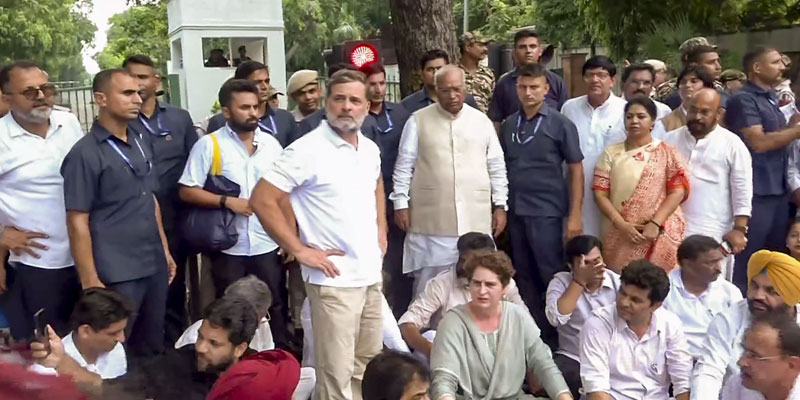
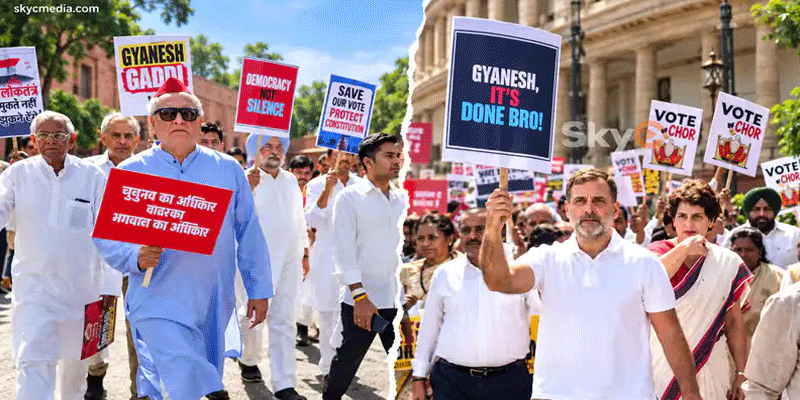
Despite restrictions, thousands of CJP supporters assembled at Jantar Mantar under the "Chalo Sansad" campaign, seeking to draw Parliament's attention to alleged examination failures and youth unemployment.
Against this backdrop, the meeting between CJP leaders and J.P. Nadda marked an important political shift. By accepting a memorandum from protest representatives, the government has opened a channel of communication without conceding the movement's principal demands. Sources further indicated that protesters would not be forcibly removed from Jantar Mantar, suggesting an effort to balance law and order with democratic accommodation. However, there has been no indication that authorities are reconsidering restrictions on marches towards Parliament.
Balancing security with political legitimacy
The government's strategy increasingly appears to combine firm security enforcement with selective engagement. Parliament remains protected through barricades, legal restrictions and heavy deployment, while Jantar Mantar continues to function as the designated space for public dissent.
For the CJP, this presents both an opportunity and a challenge. The meeting with Nadda gives the movement institutional recognition and a platform to present its demands. Yet the absence of any commitment on issues such as Dharmendra Pradhan's resignation or sweeping examination reforms means protesters may continue to rely on public mobilisation to sustain pressure.
The broader debate therefore extends beyond NEET. It raises questions about how democratic institutions respond to youth-led movements seeking accountability on education, employment and governance.
The Real Test Lies Beyond the First Meeting
The interaction between CJP leaders and J.P. Nadda marks an important opening in a confrontation that had largely unfolded on the streets. By allowing protests to continue at Jantar Mantar while initiating dialogue, the government has signalled a preference for calibrated engagement over outright confrontation. However, meaningful progress will ultimately depend not on symbolic meetings but on concrete action. If discussions translate into credible examination reforms and greater accountability, tensions may ease. If they remain limited to procedural outreach, the movement is likely to retain both its momentum and its growing national appeal.
(With agency inputs)