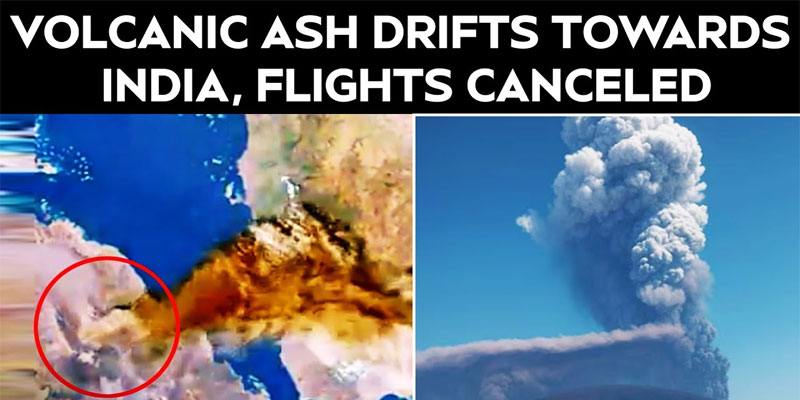
Ethiopia volcanic eruption: A volcano called Hayli Gubbi erupted in a remote region of Ethiopia. Enormous plumes of ash were blasted high into the atmosphere, rising 10 to 15 kilometers above the Danakil Desert—an area with almost no inhabitants.
A massive cloud of volcanic ash from Ethiopia's Hayli Gubbi volcano, which erupted for the first time in nearly 12,000 years, has travelled thousands of kilometres to India, reaching altitudes between 25,000 and 45,000 feet and affecting Delhi, Rajasthan, and several parts of North India. The plume, travelling at nearly 100–120 km/hour at altitudes above 10 km, contains volcanic ash, sulphur dioxide, and small particles of glass and rock.
The ash has darkened the skies and forced airlines to divert or cancel several flights. The AQI in many parts of Delhi has spiked above 400, with a layer of toxic smog settling over the city. Visibility dropped noticeably around Anand Vihar, AIIMS and Safdarjung.
IndiaMetSky Weather had earlier warned that the ash plume could make the sky appear unusually dark and hazy, and that it might disrupt air traffic, leading to delays and longer travel times.
Because of the volcanic ash, multiple flights operated by Akasa Air, IndiGo, Air India and several international carriers had to be diverted, while some were cancelled altogether due to the hazardous conditions at higher altitudes.
"Following recent volcanic activity in Ethiopia and the resulting ash plume in the surrounding airspace, our flights to and from Jeddah, Kuwait, and Abu Dhabi scheduled for 24th and 25th November 2025 have been cancelled," Akasa Air said in a statement.
The airline also said its teams will continue to assess the situation in compliance with international aviation advisories and safety protocols and take necessary actions as required.
In a post on X, IndiGo said, "Following the recent eruption of the #HayliGubbi volcano in #Ethiopia, ash clouds are reported to be drifting towards parts of western India. We understand that such news may cause concern, and we want to reassure you that your safety remains our highest priority."
"Our teams are closely tracking the situation in coordination with international aviation bodies. We are fully prepared with all necessary precautions to ensure safe and reliable operations," it said.
In a post on X late on Monday, Air India said, "Following the volcanic eruption in Ethiopia, ash clouds have been observed over certain geographical regions. We are closely monitoring the situation and remain in constant touch with our operating crew. There is no major impact on Air India flights at this time."
The following Air India flights have been cancelled as we carry out precautionary checks on those aircraft which had flown over certain geographical locations after the Hayli Gubbi volcanic eruption: Air India
Cancelled Flights:
AI 2822 – Chennai–Mumbai
AI 2466 – Hyderabad–Delhi
AI 2444 / 2445 – Mumbai–Hyderabad–Mumbai
AI 2471 / 2472 – Mumbai–Kolkata–Mumbai
The Directorate General of Civil Aviation (DGCA) issued an advisory instructing airlines to avoid ash-laden regions, reroute aircraft, and conduct thorough engine inspections. Volcanic ash poses severe risks to aircraft, including engine failure, abrasion of cockpit windows, and interference with navigation systems.
Ash cloud to clear India by 7.30 pm: IMD
Ash clouds from volcanic activity in Ethiopia are drifting towards China and will move away from India by 7.30 pm on Tuesday, the India Meteorological Department said. Forecast models indicated ash influence over Gujarat, Delhi-NCR, Rajasthan, Punjab and Haryana on Tuesday, the India Meteorological Department (IMD) said.
IMD Director General Mrutyunjay Mohapatra said the ash clouds are drifting towards China and will move away from Indian skies by 7.30 pm. According to the IMD, Hayli Gubbi, a shield volcano in Ethiopia's Afar region, erupted on Sunday, producing a large ash plume that rose to around 14 km (45,000 ft).
The plume spread eastward across the Red Sea and towards the Arabian Peninsula and the Indian subcontinent.
"High-level winds carried the ash cloud from Ethiopia across the Red Sea to Yemen and Oman and further over the Arabian Sea towards western and northern India," the IMD said in a statement.
It said the IMD closely monitored satellite imagery, advisories from Volcanic Ash Advisory Centres (VAACs) and dispersion models.
Its Met Watch Offices in Mumbai, New Delhi and Kolkata issued ICAO-standard Significant Meteorological Information (SIGMET) warnings to airports. These advisories included directions to avoid affected airspace and flight levels identified in the VAAC bulletins.