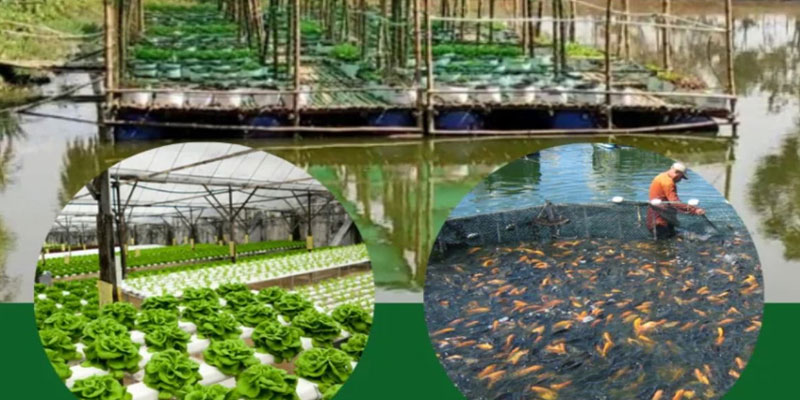
A farmer from Sundargarh in Odisha has stunned social media users and agricultural experts alike with an ingenious farming model. By engineering a trellis system over his fish pond, he has transformed a single plot into a dual-income ecosystem—growing vegetables overhead while cultivating fish beneath. The innovation has sparked discussion on how integrated pond-based farming could help smallholders maximise returns from limited land.
A Grassroots Innovation Gains Attention
The Sundargarh farmer’s method reflects a broader shift toward resource-efficient, climate-resilient agriculture. With landholdings shrinking and water stress rising across many districts, farmers are increasingly experimenting with integrated models that combine aquaculture and horticulture.
In this case, a trellis built over the pond supports climbing vegetables such as bottle gourd and bitter gourd. The plants benefit from moisture and nutrients generated by the fish below, while the shaded water improves fish growth conditions. This simple yet effective arrangement demonstrates how traditional knowledge and low-cost engineering can significantly boost farm productivity.
How the Pond-Trellis Model Works
The system involves installing bamboo or metal frames across a pond to support creepers. Vegetable vines spread across the structure, allowing fruits to hang above the water. Fish waste provides natural nutrients that enrich the water, which in turn nourishes plant roots and reduces the need for chemical fertilisers.
Farmers benefit in multiple ways. Vegetable cultivation generates short-term cash flow, while fish farming offers steady seasonal income. Water evaporation from the pond creates humidity that supports plant growth, and the vine canopy helps regulate pond temperature. Together, these factors reduce input costs and improve yields.
The model is especially suitable for regions with small landholdings and existing farm ponds. In districts like Sundargarh, where many farmers depend on rain-fed agriculture, such integrated systems offer resilience against erratic weather and fluctuating market prices.
Government Subsidies for Pond-Based Vegetable Farming in Odisha
· Matsya Pokhari Yojana (Fish Pond Scheme): Provides 40–50% subsidy on pond excavation (0.2–2 hectares, minimum depth six feet) for intensive freshwater aquaculture. Eligible applicants are Odisha residents with clear land titles, Aadhaar and bank accounts. Support is available for up to two hectares, including prior beneficiaries.
· Mukhyamantri Matsyajibi Kalyan Yojana: Offers input assistance such as fingerlings and feed for ponds created under rural employment schemes, helping farmers integrate fish and vegetable cultivation.
· Intensive Freshwater Aquaculture Subsidy: Back-ended financial aid for new tanks and ponds aimed at boosting fish production, which complements vegetable trellis systems built over water bodies.
· Horticulture Department Schemes: Provide subsidies for trellis or pandal systems and micro-irrigation infrastructure under national horticulture programmes. Assistance may cover 50–75% of costs, with support of up to ₹1–2 lakh per hectare for poles, nets and drip systems used for climbing vegetables.
· Pradhan Mantri Krishi Sinchayee Yojana (PMKSY): Offers up to 100% subsidy for small and marginal farmers and about 75% for others (up to five hectares) for micro-irrigation and efficient water-use systems, complementing pond-based cultivation.
A Model for Sustainable Smallholder Growth
The Sundargarh farmer’s success underscores how innovation at the grassroots can reshape agricultural practice. Integrated pond farming offers a practical route to higher incomes, efficient resource use and climate resilience. With targeted subsidies and technical support, such models could be replicated across Odisha and other states facing similar challenges.
As policymakers seek to double farmers’ incomes and promote sustainable agriculture, this simple trellis-over-pond system demonstrates that transformative solutions often emerge from local ingenuity rather than large-scale infrastructure alone.
(With agency inputs)