A Sudden Disclosure, A Familiar Pattern
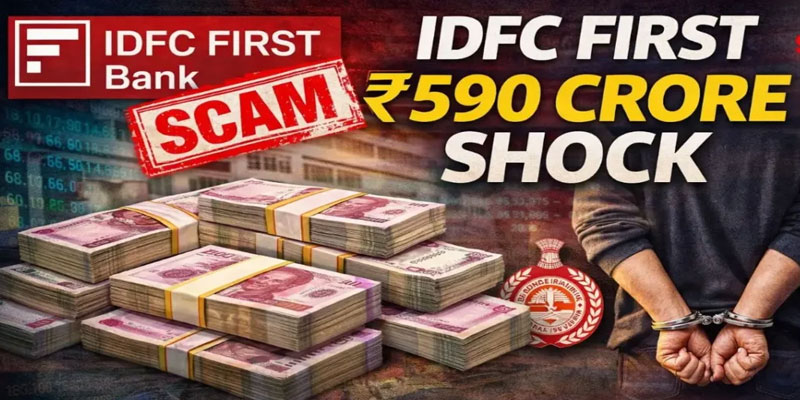
On February 22, 2026, IDFC First Bank disclosed a ₹590-crore fraud at its Chandigarh branch, sending ripples through India’s banking sector. The irregularities, uncovered during routine account closures beginning February 18, involved alleged manipulation of Haryana government-linked accounts by suspended employees in collusion with external parties. Unauthorized transfers were reportedly made to beneficiary accounts outside the branch, prompting internal investigations, police FIRs, notification to the Reserve Bank of India (RBI), and a forensic audit by KPMG.
The bank has emphasized that the issue is confined to specific accounts and does not reflect broader operational weaknesses. Nonetheless, the episode has reignited concerns about governance, internal controls, and collusion risks within India’s financial system.
How the Fraud Unfolded
The discrepancies surfaced when Haryana-linked entities flagged mismatched balances. Subsequent audits revealed unauthorized diversions and manipulation of records. Four officials have been suspended pending civil and criminal proceedings, and lien marks have been placed on certain accounts to facilitate potential recovery.
While the bank has cautioned that the final financial impact will depend on claims validation and litigation outcomes, analysts estimate the net hit could narrow to ₹200–300 crore if recoveries materialize. Shares initially fell nearly 5% before stabilizing on management assurances.
Yet the incident reflects deeper sectoral vulnerabilities. Reported banking frauds in FY25 reportedly rose 15% to around ₹31,000 crore. Recent precedents—including a ₹1,200-crore derivatives scam at Punjab National Bank and a ₹100-crore internal siphoning case at Karnataka Bank—underscore persistent gaps in KYC enforcement, dual controls, and transaction monitoring.
Governance Gaps and Structural Pressures
The IDFC First case highlights risk inherent in high-value government-linked accounts, where override mechanisms and internal collusion can bypass automated safeguards. Despite RBI’s strengthened fraud monitoring systems and AI-enabled surveillance tools, human collusion remains difficult to pre-empt.
Private lenders undergoing rapid retail expansion, such as IDFC First Bank—formed through the merger of IDFC Bank and Capital First—may also face cultural integration challenges that dilute risk discipline. The episode raises questions about whether internal audit frameworks and early warning systems were sufficiently robust at the branch level.
Importantly, RBI Governor Sanjay Malhotra characterized the case as “non-systemic,” signaling containment but not complacency.
What Regulatory Actions Might RBI Take?
While no immediate punitive action has been announced, RBI is expected to initiate a special on-site inspection at the Chandigarh branch under Early Warning System norms for frauds exceeding ₹100 crore. The regulator will likely scrutinize internal controls, KYC adherence, supervisory oversight, and transaction trails.
Monetary penalties are probable. RBI has previously imposed fines ranging from ₹1 crore to ₹10 crore on private banks for compliance lapses. Depending on findings, similar sanctions could follow here.
More consequential measures may include temporary business restrictions—such as limiting exposure to government accounts, tightening lending norms, or pausing branch expansion—if material weaknesses are identified. The bank will also be required to submit detailed fraud reports (FMR-2) and upgrade its AI-driven anomaly detection frameworks.
In extreme cases, sustained governance concerns can trigger enhanced supervisory monitoring akin to Prompt Corrective Action (PCA) thresholds, though that appears unlikely at this stage.
A Wake-Up Call Beyond One Branch
IDFC First Bank’s ₹590-crore fraud may be operationally contained, but its implications are broader. It underscores the enduring challenge of internal collusion in a digitizing banking ecosystem where technological safeguards cannot fully substitute ethical governance.
For RBI, the priority will be calibrated oversight—strong enough to deter recurrence, yet measured enough to avoid systemic alarm. For the bank, reputational repair may prove more demanding than financial recovery.
Ultimately, India’s banking clean-up requires not only tighter regulation but a deeper culture of accountability, technological vigilance, and institutional integrity. This episode serves as a timely reminder that trust remains the sector’s most valuable—and vulnerable—asset.
(With agency inputs)