India’s garment makers are reassessing their heavy reliance on the United States after tariff shocks disrupted export orders, squeezed profit margins and forced manufacturers to absorb additional costs. The uncertainty has triggered a strategic shift towards Europe, the United Kingdom, the Gulf and India's expanding domestic market. Even if New Delhi and Washington eventually conclude a bilateral trade agreement, exporters increasingly believe that depending excessively on a single destination is no longer commercially sustainable.
US Tariffs Trigger Export Market Realignment
The United States has traditionally been one of India's largest markets for textiles, garments and home furnishings. However, recent tariff uncertainty has affected shipments and weakened the confidence of exporters and international buyers.
According to the Global Trade Research Institute, India's textile, apparel and home-furnishings exports to the US declined 9.8% year-on-year to $4 billion during April-August. In contrast, shipments to other international markets increased 3.7% to $15.2 billion.
Consequently, the US share of India's exports declined to 25.4% by August-end, compared with 28.3% in 2022.
The transformation is particularly visible at Orient Craft, which reduced its US sales contribution from 84% before the tariff disruptions to less than 10%. The company has redirected production towards British and European retailers, including Next and Marks & Spencer.
Europe, Britain and Gulf Emerge as Alternatives
Tariff uncertainty has made American sourcing arrangements increasingly unpredictable. Exporters report that US buyers are demanding price concessions and asking Indian manufacturers to absorb part of the additional tariff burden. This is particularly challenging because apparel manufacturing margins frequently remain below 10%.
Consequently, companies are exploring alternative destinations:
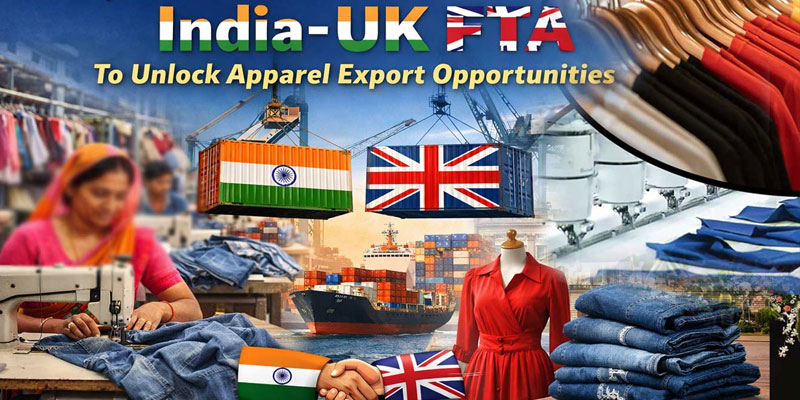
· United Kingdom: The India-UK trade agreement, effective from July, provides duty-free access for Indian garments.
· European Union: A prospective trade agreement could eliminate existing EU duties of 12-17%, improving competitiveness.
· Continental Europe: Germany, France, Italy and the Netherlands are emerging as important expansion targets.
· Gulf markets: Exporters are exploring opportunities to broaden their customer base and reduce geographical concentration.
Several manufacturers expect Europe's contribution to their revenues to increase substantially over the next three to five years.
Indian States Compete for Manufacturing Investments
Reducing production costs has become equally important. States are competing through investment incentives, subsidised facilities, easier land access and workforce availability.
Ranchi in Jharkhand is emerging as an attractive manufacturing destination. Gokaldas Exports already operates two factories there and plans a third, potentially generating up to 4,600 jobs. The company estimates at least a 10% efficiency advantage compared with other locations.
Such cost-efficient manufacturing hubs could strengthen India's competitiveness against Bangladesh and Vietnam.
Domestic Demand Provides a Safety Net
India's apparel market, valued at approximately $150 billion, is expanding annually by 7-8%. Growing domestic consumption offers manufacturers an alternative revenue stream when overseas orders weaken, helping maintain production capacity and cash flows.
Can a US Trade Agreement Reverse the Shift?
A prospective India-US Bilateral Trade Agreement could restore confidence and improve market access. However, exporters are unlikely to abandon diversification simply because tariff conditions improve.
Diversification Is India's New Competitive Advantage
The tariff shock has exposed the risks of excessive dependence on one export destination. India's garment industry must now combine competitive manufacturing, diversified international markets and stronger domestic demand. The US will remain important, but its dominance in exporters' business strategies is likely to diminish. Ultimately, this transition could become an opportunity to build a more resilient, employment-generating and globally competitive textile industry.
(With agency inputs)