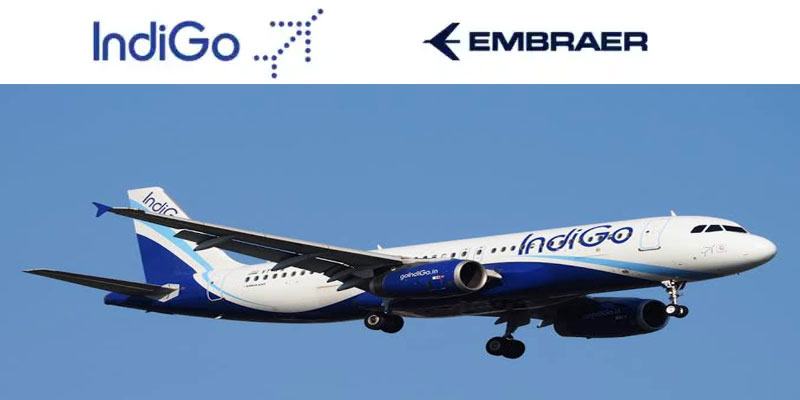
A potential 150-aircraft deal could transform regional connectivity and reshape India's aviation market. IndiGo is reportedly in discussions with Brazilian aircraft manufacturer Embraer to acquire 100 regional jets, with an option for around 50 additional aircraft. If finalised, the proposed deal would mark a significant strategic shift for India's largest airline and give Embraer a major breakthrough in the country's rapidly expanding aviation market. However, negotiations remain at an early stage, with no confirmed aircraft model, order quantity, pricing or contractual agreement.
Why IndiGo Needs Smaller Jets
IndiGo has built its dominance around the Airbus A320 family, operating a large fleet to serve high-demand domestic and international routes. Its low-cost business model relies on operational efficiency, high aircraft utilisation and economies of scale.
However, the airline faces a capacity challenge on regional routes where passenger demand is insufficient to justify deploying larger A320-family aircraft but exceeds the capacity offered by smaller turboprops.
· E190-E2: Typically accommodates around 100–114 passengers.
· E195-E2: Typically accommodates around 132–146 passengers.
These aircraft occupy the middle ground between turboprops and conventional narrowbody jets, making them suitable for shorter routes and emerging regional markets.
The Latest Development: A Potential 150-Jet Deal
According to a Reuters report dated November 4, 2026, IndiGo is in preliminary negotiations with Embraer for 100 regional jets, with options for approximately 50 more.
Three people familiar with the discussions indicated that the negotiations are still exploratory. Neither the aircraft model nor the final order size has been decided, and the proposed transaction is not guaranteed.
If an agreement materialises, deliveries are unlikely to begin before 2030. A 100-aircraft purchase could be worth billions of dollars at catalogue prices, although actual airline transactions generally involve substantial commercial discounts. No official deal value has been disclosed.
IndiGo and Embraer had not immediately responded to requests for comment.
Importantly, this is not the first time the airline has explored regional aircraft. Discussions involving ATR, Embraer and Airbus were reported as early as 2024. In August 2026, IndiGo's incoming CEO Willie Walsh was also reported to be evaluating Embraer's E190-E2 and E195-E2 aircraft.
What The Proposed Deal Means for Indian Aviation
A potential order of this magnitude could have far-reaching implications.
For IndiGo:
· Introduces a new aircraft category into its predominantly Airbus-based fleet.
· Makes thinner regional routes commercially viable.
· Allows better capacity management according to passenger demand.
· Creates opportunities to expand into underserved destinations.
For Embraer:
· Provides a potential breakthrough in one of the world's fastest-growing aviation markets.
· Establishes a major Indian airline as a customer.
· Strengthens its position against Airbus, Boeing and ATR.
For Indian aviation:
· Could improve connectivity between smaller cities and emerging economic centres.
· Encourages more efficient deployment of aircraft.
· Intensifies competition in the regional aviation segment.
· Supports the expansion of India's domestic air travel ecosystem.
The Challenges: Fleet Complexity and Economics
Despite the strategic attraction, introducing an entirely new aircraft family is not without challenges. IndiGo will have to consider pilot recruitment and training, maintenance infrastructure, spare-parts management, airport compatibility and operational integration.
These factors are particularly important for a low-cost airline whose competitive advantage depends on maintaining fleet standardisation, controlling costs and maximising aircraft utilisation.
The economics of regional routes will also determine whether the investment delivers sustainable returns.
A Potential Turning Point for Regional Connectivity
If the negotiations translate into a confirmed order, the proposed Embraer deal could represent a defining moment for India's aviation industry. It would allow IndiGo to move beyond its traditional large narrowbody operations and pursue a more differentiated regional expansion strategy.
For Embraer, it could finally open the doors to a major Indian airline customer. More importantly, the move could address a long-standing gap in India's aviation network: connecting smaller cities with the country's expanding economic centres through appropriately sized aircraft. The opportunity is substantial, but until a contract is signed, the proposed 100-plus-50 aircraft deal remains an ambitious possibility rather than a confirmed business commitment.
(With agency inputs)