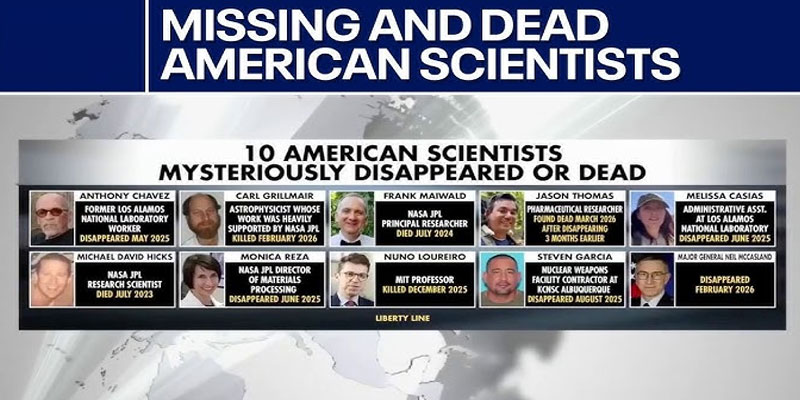
Federal authorities are investigating the deaths and disappearances of at least 10 U.S. scientists and staff linked to nuclear and space-technology programmes, a development that is increasingly being viewed as alarming despite no confirmed connection between the cases so far.
The unfolding situation has drawn attention from top federal agencies, with the FBI leading efforts to determine whether these incidents are isolated or part of a broader pattern. The individuals involved were associated with some of the most sensitive and prestigious institutions in the United States, including NASA’s Jet Propulsion Laboratory (JPL), Los Alamos National Laboratory, MIT, Caltech, and the Kansas City National Security Campus.
While authorities have not confirmed any direct link between the cases, the clustering of incidents within such high-security and strategically important organisations has raised serious concerns. The involvement of agencies like the Department of Energy and the Department of Defense further underscores the potential national security implications.
Scope and Nature of the Cases
Reports indicate that these cases date back to 2023 and involve personnel working in highly specialised and sensitive fields such as nuclear weapons components, plasma physics, rocket propulsion, and planetary defense. At least three individuals connected to NASA-JPL are among those affected—one reported missing and two deceased.
Others were affiliated with institutions like Los Alamos National Laboratory and MIT’s Plasma Science and Fusion Center, both of which play crucial roles in advancing nuclear and energy research. The Kansas City National Security Campus, responsible for manufacturing non-nuclear components for nuclear weapons, is also part of the investigation’s scope.
This concentration of incidents within critical research domains has intensified scrutiny, prompting authorities to treat the matter as potentially more than coincidental.
The Case That Drew Attention
One of the most widely discussed cases is that of Caltech astrophysicist Carl Grillmair. A respected scientist, Grillmair contributed to NASA’s NEOWISE mission and the upcoming Near-Earth Object Surveyor programme, both focused on tracking potentially hazardous asteroids.
His sudden and violent death—reportedly occurring at his residence in California—has drawn particular attention, especially as it became publicly known around the time the broader pattern of incidents began to emerge. While official statements have focused on his scientific contributions, the circumstances of his death have added to the unease surrounding the overall situation.
Speculation Versus Verified Evidence
The clustering of these incidents has inevitably led to speculation, particularly on social media, where theories ranging from espionage to targeted attacks by foreign actors have circulated widely. However, U.S. authorities have been cautious, emphasizing that no such conclusions have been reached.
Investigators are currently focused on gathering evidence and identifying any possible connections. The absence of confirmed links has not diminished concern but has instead reinforced the need for a thorough and methodical inquiry.
Institutional and Policy Implications
Even without definitive findings, the situation has already triggered internal reviews of security protocols at several research facilities. Questions are being raised about the safety of scientists working in fields that intersect with national security, as well as the adequacy of existing protective measures.
The incidents also highlight the broader vulnerability of highly specialised personnel whose expertise is critical to technological and strategic advancement.
Vigilance in an Uncertain Landscape
The deaths and disappearances of scientists tied to sensitive programmes present a troubling puzzle. Whether these incidents are ultimately linked or coincidental, they underscore the importance of safeguarding both people and knowledge in an era of increasing geopolitical complexity. As investigations continue, the priority remains clear: ensuring that the pursuit of scientific progress does not come at the cost of personal safety or national security.
(With agency inputs)