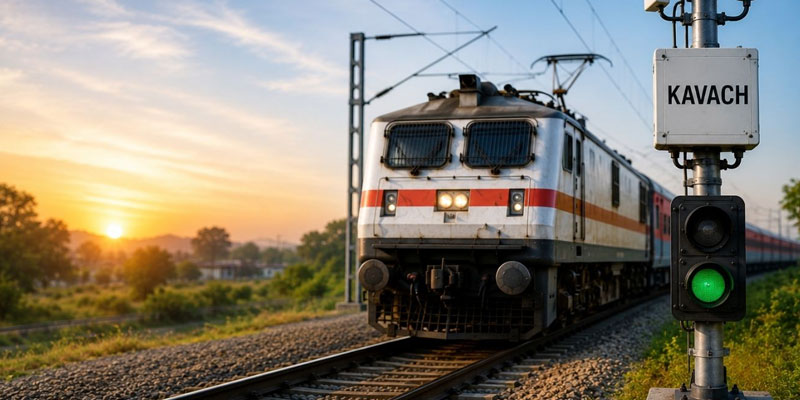
Indian Railways has approved the rollout of Kavach, its indigenous Automatic Train Protection (ATP) system, across 1,409 route kilometres in the Ambala and Ahmedabad divisions, with an investment of ₹341 crore. The move marks another significant step in the Railways’ ongoing efforts to enhance operational safety, prevent train collisions and modernize critical railway infrastructure. By extending Kavach to strategically important corridors, Indian Railways is reinforcing its commitment to safer, technology-driven train operations for millions of passengers.
Project Scope and Investment Details
The approved expansion has been divided between two major railway divisions. The Ambala Division of Northern Railway will receive an investment of ₹201 crore for Kavach deployment across 811 route kilometres. The Ahmedabad Division will receive ₹140 crore to ensure broader and more comprehensive coverage across its network.
Both divisions are crucial to India's rail transportation system. The Ambala Division serves key routes connecting Delhi with Punjab, Haryana and northern hill regions, while the Ahmedabad Division covers economically significant corridors across Gujarat. The deployment is expected to strengthen safety standards on high-density routes that handle substantial passenger and freight traffic.
What Is Kavach?
Kavach is an indigenously developed Automatic Train Protection system designed to prevent accidents through real-time monitoring and automated intervention. Developed by Indian engineers and technology firms, it serves as a technological safety shield that continuously monitors train movement and operational conditions.
Unlike imported railway protection systems, Kavach has been tailored specifically for India's vast and complex rail network. Its indigenous design not only reduces dependence on foreign technologies but also enables cost-effective deployment and future upgrades suited to local requirements.
The system represents a major milestone in India's journey towards self-reliance in advanced railway technologies.
How Kavach Enhances Railway Safety
Kavach introduces multiple layers of protection aimed at minimizing human error and preventing accidents. One of its most important functions is preventing Signal Passing at Danger (SPAD) incidents. If a locomotive attempts to cross a red signal, the system automatically applies brakes to stop the train. It also helps prevent head-on, rear-end and side collisions by ensuring trains maintain safe operating distances. Continuous speed monitoring allows Kavach to automatically intervene if a train exceeds prescribed speed limits.
In critical situations where a loco pilot may fail to react in time, the system acts as an additional safeguard by initiating corrective action. It also facilitates real-time communication between trains and trackside equipment, improving situational awareness and operational coordination.
Additional features include automatic horn activation at level crossings and emergency communication mechanisms that can alert and halt nearby trains when necessary.
Expanding a Proven Safety Framework
The latest rollout builds on the growing success of Kavach across the national railway network. The system has already been deployed on more than 2,200 route kilometres and forms a central part of Indian Railways’ broader safety modernization programme.
The expansion reflects a shift from reactive safety management to proactive risk prevention, where technology continuously monitors operations and intervenes before accidents can occur.
A Safer Future on the Rails
The ₹341 crore investment in Kavach is more than an infrastructure upgrade; it is an investment in passenger safety, operational efficiency and technological self-reliance. As Indian Railways expands the system across critical corridors, Kavach is emerging as a cornerstone of the country's railway safety transformation. Its continued deployment will not only help reduce accidents but also strengthen confidence in one of the world's largest and busiest rail networks.
(With agency inputs)