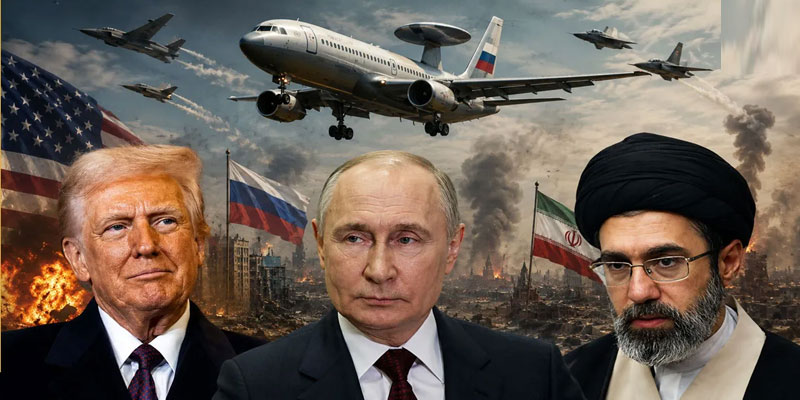
Russia Sends Elite Tu-214PU Aircraft to Tehran Amid Escalation
Russia has reportedly dispatched its elite Tu-214PU airborne command aircraft to Tehran as tensions between the United States and Iran continue to escalate over the conflict in the Gulf and the Strait of Hormuz. While the aircraft's arrival has sparked speculation about Moscow's role in the unfolding crisis, it does not indicate that Russia has directly entered the conflict. Instead, the deployment is widely viewed as a carefully calibrated geopolitical signal, suggesting high-level consultations, secure communications and strategic coordination between two increasingly close partners during a period of heightened regional instability.
Why the Tu-214PU Matters
The Tu-214PU is not an ordinary government aircraft or diplomatic transport. Operated by Russia's special flight squadron, it serves as an airborne command post equipped with advanced secure communication systems for the Kremlin's senior leadership during national emergencies and strategic crises. Its deployment is therefore generally associated with sensitive state-level consultations rather than routine diplomatic engagements.
The timing of the aircraft's reported arrival is particularly significant. It coincides with an intensification of US military strikes against Iranian targets and growing instability across the Gulf region. As attacks and counterattacks continue to threaten maritime security in the Strait of Hormuz, the presence of such a specialised command aircraft in Tehran is being interpreted as a deliberate demonstration of Russia's strategic engagement rather than a symbolic courtesy visit.
What Does the Deployment Mean?
Flight-tracking reports indicating the Tu-214PU's arrival in Tehran have fuelled speculation that Russia and Iran may be holding discussions on military-technical cooperation, intelligence sharing or broader crisis management. Neither Moscow nor Tehran has officially disclosed the purpose of the visit, leaving its exact agenda undisclosed. Consequently, the development remains an exercise in strategic signalling rather than evidence of direct military participation.
The visit also aligns with the broader trajectory of Russia-Iran relations. In January 2025, both countries signed a comprehensive 20-year strategic partnership covering defence, technology, energy, trade and regional cooperation. Against this backdrop, the aircraft's arrival appears to reinforce an already expanding partnership instead of marking a sudden shift in Russian foreign policy.
Strategically, the deployment serves multiple purposes. It signals that Russia intends to remain an influential player in any future regional settlement and does not want Iran to appear diplomatically isolated under increasing US pressure. At the same time, it conveys to Washington and its allies that Moscow can extend political support, secure coordination and potentially intelligence cooperation to Tehran without crossing the threshold into direct military intervention.
Perhaps the most significant aspect is the symbolism of the aircraft itself. As an airborne command platform designed for crisis management and continuity of government, its use implies consultations at the highest levels during an exceptionally sensitive period. Even in the absence of new military commitments, the deployment strengthens perceptions of a deepening Russia-Iran strategic alignment.
Strategic Implications for Regional Stability
For the United States, Russia's visible engagement introduces an additional layer of geopolitical complexity by linking the Iran crisis to broader great-power competition. For Iran, the presence of a high-profile Russian command aircraft serves as both reassurance and deterrence, demonstrating that it retains the backing of a major global power despite mounting international pressure.
More broadly, the episode highlights how strategic messaging has become an essential component of modern international crises. Military movements, even when non-combat in nature, often carry significant diplomatic weight.
A Powerful Signal Without Direct Military Intervention
Russia's reported deployment of the Tu-214PU to Tehran is best understood as a political and strategic signal rather than confirmation of military involvement in the US-Iran conflict. By showcasing high-level engagement at a moment of regional instability, Moscow underscores its commitment to maintaining influence in West Asia while reinforcing its growing partnership with Tehran. Although the aircraft's arrival does not alter the battlefield, it shapes diplomatic calculations, alliance dynamics and deterrence strategies, illustrating how symbolic actions can carry far-reaching geopolitical consequences.
(With agency inputs)