Minor SPA Campus Fire Triggers Major Political Storm
A minor fire on June 1, 2026, at Delhi’s School of Planning and Architecture (SPA) campus near ITO unexpectedly ignited a political controversy that extended far beyond the incident itself. What began as a routine emergency response soon evolved into a misinformation crisis after initial reports incorrectly linked the fire to the Ministry of Education. The confusion quickly attracted political reactions, with opposition leaders connecting the incident to ongoing controversies surrounding examination reforms and education governance before official clarifications were issued.
The episode serves as a reminder of how rapidly misinformation can spread in an era of instant news and heightened political polarization.
Education Ministry Under Intense Scrutiny
The fire occurred at a time when the Ministry of Education was already facing criticism over several issues. Among the most prominent was the controversy surrounding the Central Board of Secondary Education’s (CBSE) newly introduced On-Screen Marking (OSM) system, which had drawn complaints regarding evaluation discrepancies and technical glitches.
The government had also faced sustained criticism over examination management, including concerns raised in recent years about competitive entrance examinations and assessment processes. Against this backdrop, any incident perceived to involve the ministry was bound to attract immediate public and political attention.
What Actually Happened at SPA?
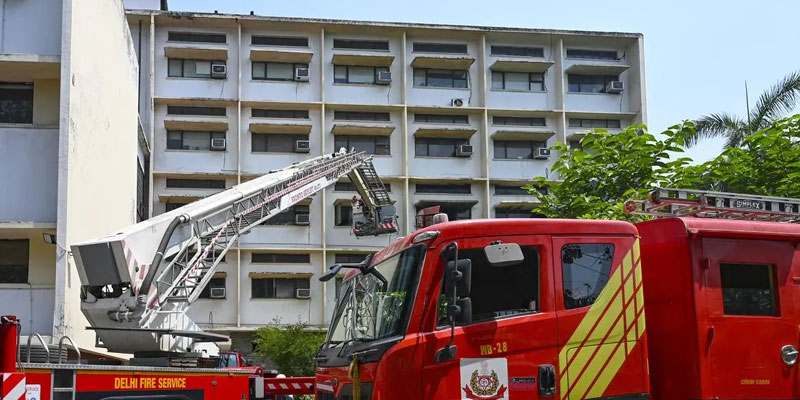
The fire broke out on the second floor of the administrative block housing faculty rooms at the School of Planning and Architecture in Indraprastha Estate near ITO. The Delhi Fire Service received an alert at approximately 9:37 a.m. and responded swiftly by deploying eight fire tenders, police personnel, and ambulances.
Emergency teams managed to bring the situation under control by around 10:40 a.m. Importantly, no casualties, injuries, or significant property damage were reported. The building was evacuated safely, and the incident remained a relatively minor fire from an operational standpoint.
However, the political impact proved far greater than the physical damage.
How Misinformation Fueled the Controversy
The controversy began when initial emergency communications reportedly identified the location as a Ministry of Education facility. Since SPA functions under the ministry’s administrative framework, the distinction between the institution and the ministry headquarters became blurred in early reports.
Several media outlets subsequently reported that a fire had occurred at the Ministry of Education office. Before authorities could issue corrections, opposition leaders reacted strongly, questioning the circumstances surrounding the incident and linking it to broader concerns about transparency and accountability in the education sector.
Some political figures suggested possible connections to ongoing disputes over CBSE’s OSM evaluation system, examination irregularities, and other education-related controversies. Social media further amplified these claims, allowing speculation to spread faster than verified information.
Official Clarification and Political Fallout
The Ministry of Education later clarified that its headquarters are located at Kartavya Bhavan-2 on Dr. Rajendra Prasad Road and were not affected by the fire. Officials emphasized that the incident was confined entirely to the SPA campus and had no connection to ministry operations.
While the clarification corrected the factual record, the incident had already become part of a wider political narrative. The episode demonstrated how existing controversies can create an environment in which unrelated events are quickly absorbed into larger debates.
Facts Matter in Times of Distrust
The SPA fire was ultimately a minor emergency that was handled effectively without loss of life or significant damage. Yet the incident exposed a deeper challenge: the speed at which misinformation can shape public perception when trust in institutions is under strain. In a politically charged environment, accurate communication becomes as important as emergency response itself. The episode underscores the need for timely clarifications, responsible reporting, and restraint in drawing conclusions before facts are fully established.
(With agency inputs)