CBSE’s On-Screen Marking System Marks a New Era
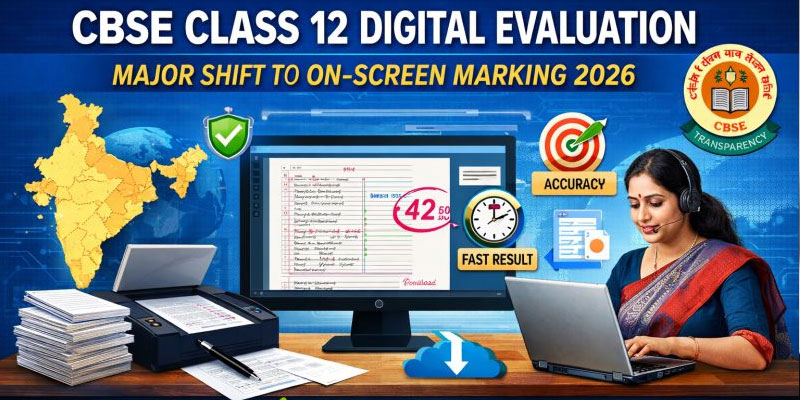
For the first time this year, the Central Board of Secondary Education (CBSE) introduced the On-Screen Marking (OSM) system, a digital evaluation mechanism designed to replace the conventional process of physically handling and assessing answer scripts. Under the new system, answer sheets are scanned and uploaded onto a digital platform where evaluators assess them electronically. The move was projected as a major step towards faster, technology-driven, and more transparent evaluation. However, instead of receiving universal acceptance, the initiative has triggered a wider debate on accountability, transparency, and trust in India’s largest school education board.
Why CBSE Adopted Digital Evaluation
CBSE’s transition to OSM is part of a broader effort to modernise examination processes in line with the goals of the National Education Policy (NEP). With millions of students appearing for board examinations annually, the board has long faced challenges related to logistics, transportation of answer books, evaluation timelines, and human errors.
The digital system was expected to streamline the process by reducing physical handling of scripts, enabling quicker assessments, and improving monitoring. According to Union Education Minister Dharmendra Pradhan, nearly 40 crore scanned pages were evaluated through OSM for the first time, covering approximately 98 lakh answer-sheet copies. While describing the initiative as a progressive and student-centric reform, the minister also acknowledged that discrepancies had emerged during implementation.
The OSM Controversy: Questions Over Accuracy and Reliability
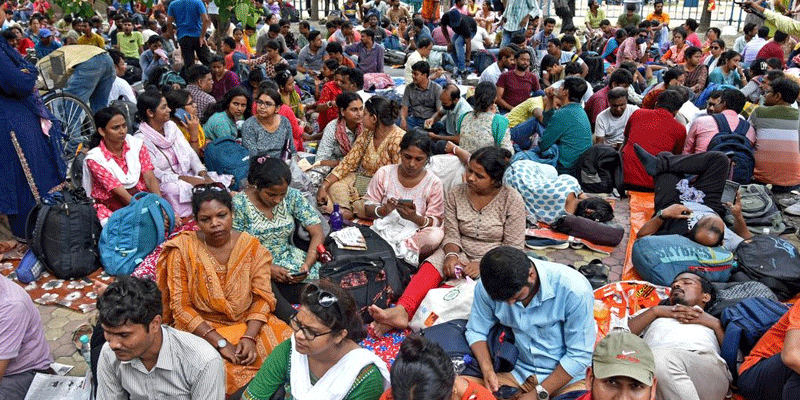
The controversy surfaced soon after Class XII results were declared. Students and parents took to social media, alleging inconsistencies in marking and raising concerns about the integrity of the digital evaluation process.
Among the complaints were reports of blurred scans, missing pages, mismatched answer sheets, and technical difficulties during result verification and re-evaluation procedures. Critics argued that such issues could directly affect students’ scores and academic futures.
The transition to a fully digital evaluation framework has therefore raised important questions about quality control, technological preparedness, and safeguards against potential errors. While CBSE maintains that the system enhances fairness and efficiency, the complaints have highlighted the challenges of implementing large-scale technological reforms in a high-stakes examination environment.
The Principals’ Video Campaign and Public Perception
The controversy intensified when several principals of CBSE-affiliated schools began posting videos endorsing OSM and urging students to trust the system. The videos drew attention because many used nearly identical language, describing the system as “transparent,” “accurate,” “faster,” and “technology-driven.”
Reports suggested that CBSE officials had informally encouraged schools to share positive messages regarding the new evaluation mechanism. Documents reportedly circulated among schools contained suggested talking points praising OSM and emphasising the board’s responsiveness to concerns.
The coordinated nature of these messages sparked criticism from parents, students, and education observers, who questioned whether the focus should have been on addressing grievances rather than managing public perception.
Beyond OSM: Can Parents Move Away from CBSE?
The episode has reignited discussions about alternatives such as ICSE, International Baccalaureate (IB), Cambridge boards, and state education boards. While many parents express frustration with CBSE’s handling of controversies, shifting away is not always practical.
CBSE remains deeply integrated with India’s higher education ecosystem and competitive entrance examinations. Factors such as affordability, accessibility, curriculum alignment, and nationwide acceptance continue to make it the preferred choice for millions of families.
Rebuilding Trust Matters Most
The OSM controversy is ultimately about more than a digital marking system. It reflects a broader challenge facing educational institutions: maintaining public trust during periods of technological transformation. While modernisation is necessary, its success depends on transparency, accountability, and responsiveness to genuine concerns. For CBSE, the real test lies not merely in digitising evaluation but in convincing students and parents that the system remains fair, reliable, and worthy of their confidence.
(With agency inputs)