Modi’s 25-Year Journey Puts Service at Centre
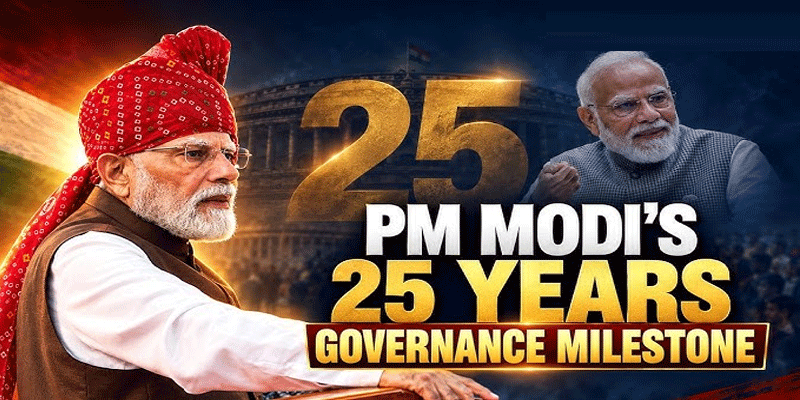
Modi at 76: the BJP has turned his birthday into a month-long service campaign, linking September 17 with the completion of 25 years since he first assumed a constitutional executive office. The Seva Sankalp Abhiyan, running from September 17 to October 17, combines public-service activities with programmes showcasing his political journey from Gujarat to the national stage.
From Vadnagar to Gujarat’s Chief Minister
Born in Vadnagar, Gujarat, on September 17, 1950, Narendra Modi entered public life through the Rashtriya Swayamsevak Sangh and subsequently rose through the BJP organisation. His transition from party organiser to executive leader came on October 7, 2001, when he became Gujarat chief minister. He remained in office until May 2014, giving him more than 12 years at the helm of the state.
The Gujarat period established the political identity that later shaped his national campaign: emphasis on infrastructure, investment, administrative delivery and direct communication. His rise accelerated after the BJP named him its prime ministerial candidate in 2013.
From Gujarat to Three Terms in Delhi
Modi became prime minister in May 2014 after the BJP secured a parliamentary majority. The party won another majority under his leadership in 2019, while the BJP-led National Democratic Alliance formed the government in 2024.
Over these years, his governments have placed emphasis on welfare delivery, financial inclusion, digital public infrastructure, sanitation, roads and railways, manufacturing, entrepreneurship and India's international engagement.
Supporters point to initiatives such as Jan Dhan, direct-benefit transfers, UPI, Swachh Bharat and expanded infrastructure as evidence of a stronger delivery-oriented state. Critics, however, have raised concerns over institutional centralisation, civil liberties and social tensions. These differing assessments remain an important part of understanding his 25-year political record.
How Modi Has Served the People For 25 Years?
The BJP's service narrative rests on several broad themes:
· Governance: greater emphasis on direct delivery of welfare benefits and digital systems.
· Infrastructure: expansion of highways, railways, airports and connectivity.
· Financial inclusion: wider access to banking and formal financial services.
· Technology: use of digital platforms to deliver public services at scale.
· Social welfare: programmes focused on housing, sanitation, cooking fuel, health and livelihoods.
· Global engagement: projecting India's economic, diplomatic and strategic interests internationally.
The record is therefore not simply about longevity in office; it is also about how governance priorities and delivery mechanisms have evolved during his tenure.
Seva Sankalp Turns Birthday into Outreach
The BJP's Seva Sankalp Abhiyan seeks to translate the anniversary into grassroots activity. Programmes include blood-donation drives, cleanliness campaigns, exhibitions, seminars, welfare outreach, youth initiatives and public-contact programmes. A major feature is the Seva Sankalp Bike Yatra, connecting Modi's birthplace Vadnagar with his parliamentary constituency Varanasi.
The campaign consequently combines biography with organisational mobilisation and public-service activities.
Twenty-Five Years, One Enduring Service Narrative
Modi's journey from a Gujarat organiser to a three-term prime minister represents one of the longest continuous political leadership arcs in contemporary India. The BJP's month-long campaign presents that journey through the language of service, development and nation-building. Yet the 25-year record also encompasses debate over governance, institutions and social policy. Ultimately, its significance lies in the scale and continuity of Modi's political career—and in the contrasting assessments of what that quarter-century has meant for India.
(With agency inputs)